


The Rise of Interactive Confectionery and Peelable Gummy Innovation
Scaling a successful confectionery brand in today’s competitive landscape requires moving beyond generic product offerings and embracing novel interactive formats. Whether launching festive holiday assortments or permanent retail lines, partnering with a wholesale peelable gummy supplier ensures access to advanced co-extrusion technology, stable hydrocolloid formulations, and rigorous international food safety standards. Global buyers must carefully evaluate factory capabilities, ingredient traceability, and total landed costs to maintain healthy profit margins while delivering exceptional sensory experiences to end consumers.
Peelable Gummy
Anatomy of a Peelable Gummy: Hydrocolloid Science and Texture Mechanics
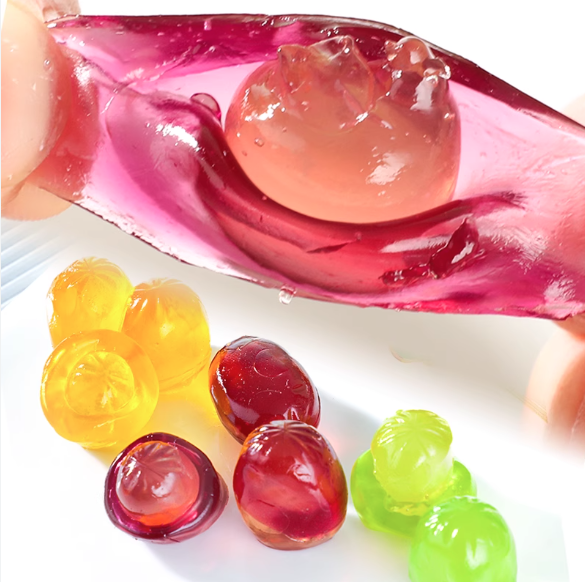
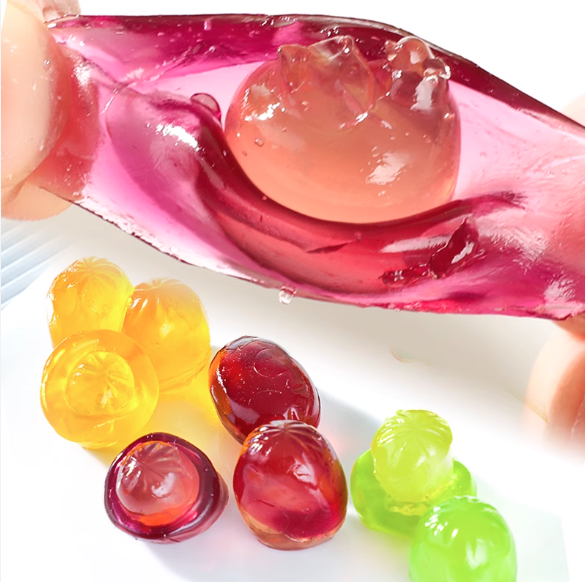
Creating a successful peelable confectionery item demands precise hydrocolloid engineering. Unlike traditional single-texture gummies, peelables require a delicate balance between an elastic, peelable outer skin and a tender, juicy inner gel core. The outer skin relies on high-methoxyl pectin or specific gelatin ratios to provide tensile strength and low surface tackiness, ensuring the skin peels away smoothly without tearing. Meanwhile, the inner core utilizes customized carrageenan or modified starch blends that maintain a fluid, melt-in-the-mouth consistency. To review our comprehensive catalog of certified agricultural inputs, food-grade hydrocolloids, and natural colorants, consult our detailed raw material sourcing and quality specifications guide.
Maintaining exact biochemical thresholds prevents product degradation and texture failure during international transport. High humidity or extreme temperature fluctuations can cause moisture migration between the outer skin and inner core, leading to premature gelling or structural collapse. Rigorous laboratory testing, including Brix level verification and moisture meter analysis, ensures that every industrial batch meets strict export durability standards.
Quantitative Parameters and Confectionery Benchmarks
Industrial production of double-layer interactive confections requires strict adherence to physical and chemical parameters. The benchmark table below outlines standard industrial tolerances for export-grade peelable formulations across key manufacturing metrics:
| Component Layer | Primary Hydrocolloid Matrix | Target Moisture Content (%) | Brix Level (Bx) | Optimal Hardness (N) |
|---|---|---|---|---|
| Outer Peelable Skin | High-Gelatin / High-Pectin Blend | 14.0% – 16.5% | 76° – 79°Bx | 8.5 – 11.0 N |
| Inner Juicy Core | Carrageenan / Pectin / Konjac Gum | 18.5% – 22.0% | 70° – 73°Bx | 3.0 – 5.0 N |
| Single-Layer Standard Gummy | Standard Bovine Gelatin (220 Bloom) | 15.0% – 18.0% | 75° – 78°Bx | 6.0 – 8.0 N |
Navigating the complexities of international trade and supply chain execution requires proven strategic frameworks. For comprehensive insights into evaluating overseas factories, mitigating logistical risks, and establishing successful import pipelines, review our expert guide on navigating successful candy sourcing from China.
Manufacturing Technology: Co-Extrusion and Starch-Mogul Precision
Producing dual-layer peelable confections relies heavily on advanced co-extrusion machinery and high-speed starch-mogul lines. The manufacturing process begins with simultaneous deposition, where the outer skin mixture and the inner core gel are injected through concentric nozzle assemblies into precision-molded starch trays or silicone molds. This requires absolute thermal synchronization; even minor temperature discrepancies between the two fluid streams can cause interfacial boundary mixing, destroying the distinct peeling effect required by consumers.
Following deposition, trays enter climate-controlled cooling and curing tunnels where relative humidity is maintained below 55 percent to stabilize moisture gradients. Once set, the gummies undergo automated starch removal, brushing, and a specialized oil-glazing process using food-grade carnauba wax or vegetable oils. This final coating prevents piece-to-piece adhesion during transit and imparts a glossy, appetizing sheen suitable for premium retail packaging.
Supply Chain Logistics, Climate Control, and Cost Optimization
Confectionery logistics present unique challenges, particularly when shipping heat-sensitive and moisture-balanced items across maritime trade lanes. Dual-layer gummies are susceptible to thermal stress, which can soften the outer skin or cause syneresis (moisture weeping) within the inner core. Importers must prioritize refrigerated (reefer) containers or utilize high-performance thermal insulated blankets during peak summer shipping windows.
Optimizing Total Landed Cost (TLC) involves balancing unit production economies with precise customs tariff classification under appropriate Harmonized System (HS) codes. Collaborating with experienced freight forwarders ensures proper documentation, FDA prior notice compliance, and minimal demurrage risks at destination ports.
Frequently Asked Questions
-
What is the typical Minimum Order Quantity (MOQ) for custom peelable gummy production runs?
Minimum Order Quantities generally range between 3,000 to 5,000 kilograms per flavor SKU for standard stock molds. For entirely bespoke mold designs, proprietary fruit shapes, or customized multi-color retail packaging, MOQs typically start around 10,000 units to cover initial engineering and setup expenses.
-
How do manufacturers achieve the peeling texture without the outer skin tearing?
The distinct peeling texture is achieved through precise hydrocolloid formulation, maintaining differential moisture levels between the outer skin and inner core, and utilizing advanced co-extrusion deposition technology that creates a clean interfacial boundary without fusing the layers together.
-
What international food safety certifications should a reliable supplier possess?
Top-tier manufacturing facilities maintain internationally recognized certifications including BRCGS, ISO 22000, HACCP, FDA facility registration, and Halal or Kosher accreditations, ensuring full compliance with strict global import regulations.
-
What measures prevent peelable gummies from melting or sticking during ocean transit?
Preventing transit damage requires utilizing refrigerated containers maintained between 15°C and 20°C, deploying food-grade anti-stick glazing agents, and incorporating high-performance desiccant packs to control relative humidity inside export cartons.
-
What is the average lead time from initial sample approval to final delivery?
The standard lead time spans 45 to 75 days, encompassing 7 to 14 days for custom sample development and courier delivery, 20 to 35 days for mass production and quality testing, and 15 to 30 days for ocean freight transit and customs clearance.
Comprehensive Industry Context
The 2026 confectionery market is defined by consumer demand for immersive, sensory-driven treats. Peelable confections represent a high-margin growth category that requires advanced manufacturing capabilities, precise hydrocolloid science, and rigorous quality assurance.
Feature Product
-
 Gummy Candy
What Is Gummy Candy? Gummy Candy is one of the ...
-
 Crispy Gummy Candy
What Is Crispy Gummy Candy Crispy Gummy Candy i...
-
 Peelable Gummy Candy
What Is Peelable Gummy Candy? Peelable Gummy Ca...