

1. What Are Peelable Gummies?
Definition of Peelable Gummy Candy
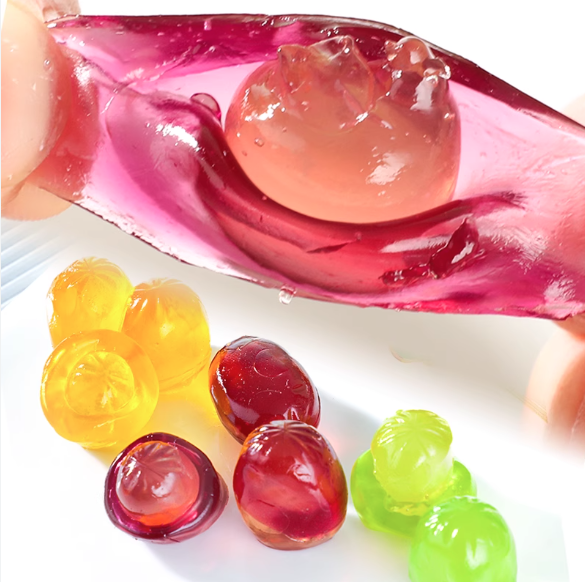
Peelable gummies are chewy confectionery products designed with a peelable outer layer and an inner gummy component. The outer layer is generally thinner, flexible, and sufficiently cohesive to be removed by hand, while the center provides the main chewy texture and flavor experience.
This structure creates a clear difference between Peelable Gummies and conventional gummy candy. A traditional gummy is normally formulated as one integrated gel structure. A peelable gummy, by contrast, is developed around the relationship between at least two textural components.
The result is an interactive product that combines visual appeal, tactile interaction, and eating enjoyment.
Many commercial formats use fruit-inspired designs. Mango, watermelon, grape, strawberry, banana, peach, and other recognizable fruit shapes can make the product immediately understandable to consumers.
The product concept has also expanded into novelty shapes, character designs, seasonal products, mixed-flavor formats, and custom private-label concepts.
Why the Peel-Away Experience Matters
The defining characteristic of peelable gummy candy is not simply its shape. It is the action of peeling.
This creates a sequence:
See → Touch → Peel → Reveal → Eat
That sequence can make the product more engaging than a conventional single-texture gummy.
For retailers, this interaction can also create a stronger product story. Instead of selling only flavor and sweetness, a brand can communicate an experience.
For example, a mango-shaped gummy can be designed to resemble a miniature fruit, while the consumer physically removes the outer “skin” before eating the center.
This makes fruit-shaped peelable gummies particularly suitable for novelty candy, convenience retail, gift products, online candy stores, seasonal collections, and social-media-oriented product concepts.
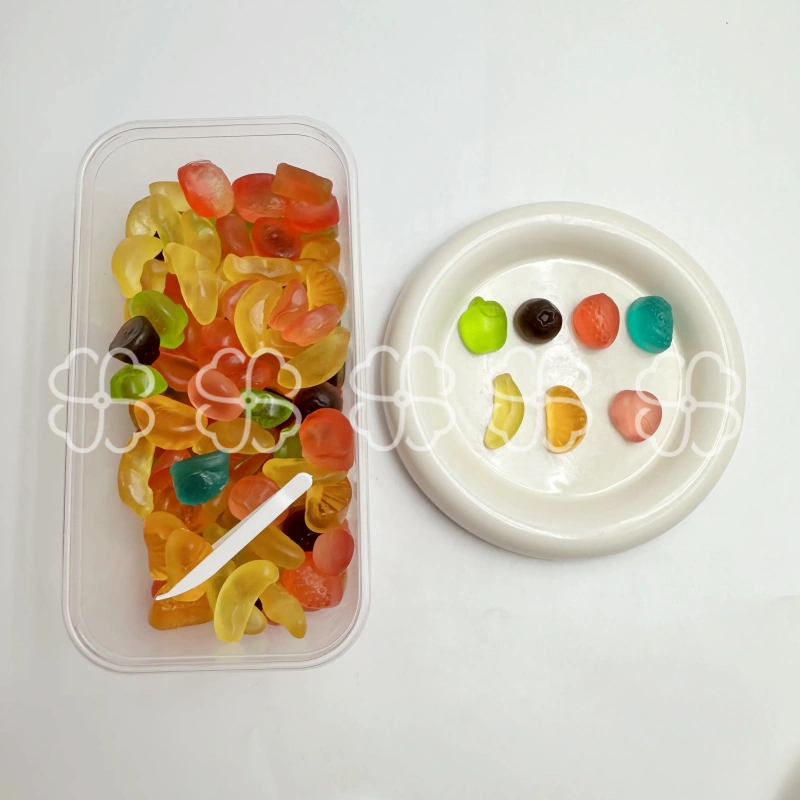
Mixed Fruit Flavored Peelable Gummy
Peelable Gummies vs. Traditional Gummies
The difference can be summarized through product architecture rather than simply appearance.
| Feature | Peelable Gummies | Traditional Gummies |
|---|---|---|
| Product structure | Multi-texture or layered | Usually integrated texture |
| Outer layer | Designed for peeling | Not normally peelable |
| Eating process | Peel and eat | Eat directly |
| Texture | Outer layer + center | Usually more uniform |
| Interactive experience | High | Product dependent |
| Shape customization | High | High |
| Flavor customization | High | High |
| OEM potential | High | High |
| Packaging requirements | Requires attention to shape and adhesion | More conventional |
| Consumer education | Usually simple | Minimal |
Neither format is inherently better for every market. The right choice depends on the buyer’s target consumer, price point, retail channel, product positioning, and desired eating experience.
2. How Do Peelable Gummies Work?
The Outer Peelable Layer
The outer layer is one of the most technically important parts of a peelable gummy.
It needs enough strength to remain intact during production, packaging, transportation, and handling. At the same time, it needs controlled adhesion so consumers can separate it from the center without excessive force.
If the outer layer is too weak, it may break during handling.
If it adheres too strongly to the center, the product may lose its intended peeling experience.
Therefore, peelability is a product-development target rather than simply a visual characteristic.
The Soft Inner Gummy Center
The center generally provides a different chewing experience from the outer layer.
A successful product may create a noticeable contrast:
- Slightly firmer outer skin
- Softer or more elastic center
- Different flavor intensity
- Different color
- Different moisture characteristics
The contrast is what makes the product feel interactive.
What Makes a Gummy Easy to Peel?
Peeling performance can be influenced by several variables:
- Hydrocolloid selection
- Solids concentration
- Moisture distribution
- Layer thickness
- Gel strength
- Cooling conditions
- Surface treatment
- Temperature during processing
- Storage conditions
- Packaging protection
This is why simply copying the appearance of a peelable gummy does not guarantee the same consumer experience.
A manufacturer needs to control the relationship between the outer and inner structures.
Texture, Elasticity, Adhesion and Moisture Balance
Texture is one of the most important quality attributes in gummy confectionery.
A peelable product has an additional requirement: the outer layer must separate from the center in a controlled way.
This means product development often involves balancing:
| Property | Desired Commercial Effect |
|---|---|
| Elasticity | Helps prevent tearing |
| Cohesion | Keeps the outer layer intact |
| Adhesion | Allows controlled contact between layers |
| Moisture balance | Supports texture and stability |
| Gel strength | Helps maintain shape |
| Surface condition | Reduces unwanted sticking |
| Layer thickness | Influences peeling behavior |
These properties should be tested together rather than optimized independently.
3. How Are Peelable Gummies Made?
Ingredient Preparation
The manufacturing process starts with controlled preparation of the gummy ingredients.
Depending on the formulation, these may include sugar, glucose syrup or other sweeteners, gelatin or plant-based hydrocolloids, acids, flavors, colors, fruit components, and processing aids.
The exact formulation varies according to the desired texture, target market, product design, regulatory requirements, and consumer positioning.
Outer-Layer Formulation
The outer layer needs to perform several functions simultaneously.
It must:
- Maintain the intended shape
- Resist tearing
- Separate from the center
- Remain stable during storage
- Provide the desired appearance
- Support flavor delivery
The formulation therefore needs to be designed specifically for a peelable application rather than simply adapting a traditional gummy formula.
Inner Gummy Formulation
The center can be developed with a different texture or flavor profile.
For example, a manufacturer might create:
- Mango skin + mango center
- Strawberry skin + strawberry center
- Grape skin + mixed fruit center
- White peach skin + peach center
- Banana skin + creamy or fruit-flavored center
This opens opportunities for multi-flavor and surprise concepts.
Dual-Layer Molding or Depositing
One important manufacturing challenge is bringing the outer and inner components together while maintaining their intended geometry.
Depending on the equipment and product design, manufacturers may use controlled depositing, molding, cooling, setting, demolding, and finishing processes.
The critical objective is consistency.
Every piece should ideally have similar:
- Weight
- Shape
- Layer thickness
- Center position
- Surface appearance
- Peeling behavior
For commercial production, consistency is just as important as the first successful sample.
Cooling, Setting and Demolding
After forming, the gummy structure needs to stabilize.
Temperature, time, humidity, and formulation all affect the final texture.
A manufacturing process therefore needs appropriate controls rather than relying on a single temperature or processing time.
Once the structure has stabilized, the product can move through demolding, surface treatment, inspection, and packaging.
Quality Inspection and Packaging
Quality control should cover both food safety and product functionality.
For peelable gummies, inspection may include:
- Appearance
- Color
- Weight
- Shape
- Surface condition
- Layer integrity
- Peeling performance
- Flavor consistency
- Packaging seal
- Batch traceability
For a buyer evaluating a Peelable Gummy Manufacturer, these controls are important because a product can meet basic food-quality requirements while still failing to deliver consistent peeling performance.
4. What Ingredients Are Used in Peelable Gummy Candy?
Gelatin
Gelatin is widely used in gummy confectionery because it can provide elasticity, chewiness, and gel strength.
Its characteristics can influence:
- Firmness
- Elasticity
- Chew
- Setting behavior
- Temperature sensitivity
For peelable applications, gelatin selection and concentration need to be considered together with the outer-layer design.
Pectin and Other Hydrocolloids
Pectin can be used in gummy formulations where a plant-based or different texture profile is desired.
Other hydrocolloids may also be considered depending on the target texture and formulation system.
The important point for buyers is that “gelatin vs. pectin” is not simply a universal better-or-worse decision.
The choice should be based on:
- Target texture
- Market requirements
- Dietary positioning
- Formulation stability
- Processing method
- Consumer expectations
Sugar and Glucose Syrup
Sweeteners influence sweetness, solids content, texture, viscosity, and processing behavior.
In gummy systems, sugar and syrup also interact with the hydrocolloid network and moisture balance.
This means the final texture depends on the complete formulation rather than one ingredient.
Fruit Flavors and Fruit Components
Fruit flavor is particularly important for peelable gummies because many products use realistic fruit shapes.
Popular concepts include:
- Mango
- Strawberry
- Grape
- Peach
- White peach
- Lychee
- Banana
- Watermelon
- Mixed fruit
For B2B development, flavor selection should consider the target market rather than assuming one flavor has the same commercial potential everywhere.
Acids and pH Control
Food acids can contribute to flavor balance and formulation characteristics.
However, acid level needs to be controlled because acidity can interact with hydrocolloid systems and affect texture.
For this reason, formulation development should evaluate flavor, pH, gel structure, processing stability, and shelf life together.
Gelatin vs. Pectin for Peelable Gummies
| Factor | Gelatin-Based | Pectin-Based |
|---|---|---|
| Texture | Elastic and chewy | Can be firmer or shorter |
| Plant-based positioning | No | Potentially yes |
| Flavor release | Formulation dependent | Formulation dependent |
| Processing | Requires controlled temperature | Different setting conditions |
| Market positioning | Conventional gummy profile | Vegan/plant-based potential |
| Peelability | Formulation dependent | Formulation dependent |
A professional manufacturer should select the hydrocolloid system according to the complete product specification instead of using a one-size-fits-all formula.
5. What Makes a High-Quality Peelable Gummy?
Easy Peeling Performance
The first test should be simple:
Can the consumer peel the product naturally without excessive force?
The outer layer should separate predictably without disintegrating immediately.
Shape Retention
Fruit-shaped products need good dimensional stability.
A mango should still look like a mango after manufacturing, packing, transportation, and retail handling.
Shape retention is particularly important for visually driven products.
Texture Consistency
A commercial product should deliver a similar experience from piece to piece.
Inconsistent texture can occur when formulation, moisture, cooling, depositing, or storage conditions vary.
Flavor Consistency
Flavor should remain consistent between production batches.
For private-label buyers, this matters because consumers expect the second purchase to taste similar to the first.
Surface Appearance
Surface defects can reduce perceived quality.
Common issues that buyers may inspect include:
- Cracks
- Deformation
- Excessive stickiness
- Uneven color
- Air bubbles
- Surface damage
- Irregular shape
Resistance to Sticking and Deformation
Packaging and transport can expose gummies to temperature changes, pressure, and humidity.
A well-designed product needs to remain commercially acceptable under its expected distribution conditions.
6. Popular Peelable Gummy Flavors
Flavor selection should combine consumer familiarity with visual compatibility.
Mango Peelable Gummy
Mango is particularly suitable for fruit-shaped concepts because its natural visual identity is strong.
A mango peelable gummy can use an orange-yellow exterior with a softer mango-flavored center.
Strawberry Peelable Gummy
Strawberry offers a strong visual identity through red or pink color.
It can also be combined with cream, yogurt, mixed berry, or other complementary concepts.
Grape Peelable Gummy
Grape can be presented through purple or dark-violet color systems.
The flavor works well for both single-flavor and mixed-fruit collections.
Peach and White Peach
Peach and white peach can support a softer visual style and a delicate flavor profile.
They are suitable for brands seeking a less intense fruit concept.
Banana Peelable Gummy
Banana-shaped products can create immediate visual recognition.
The shape itself can become part of the product’s marketing message.
Lychee Peelable Gummy
Lychee offers another option for Asian-inspired fruit collections and mixed tropical fruit assortments.
Mixed Fruit Peelable Gummies
Mixed collections allow buyers to test several flavors in one SKU.
For retail launches, this can also make the product visually more varied.
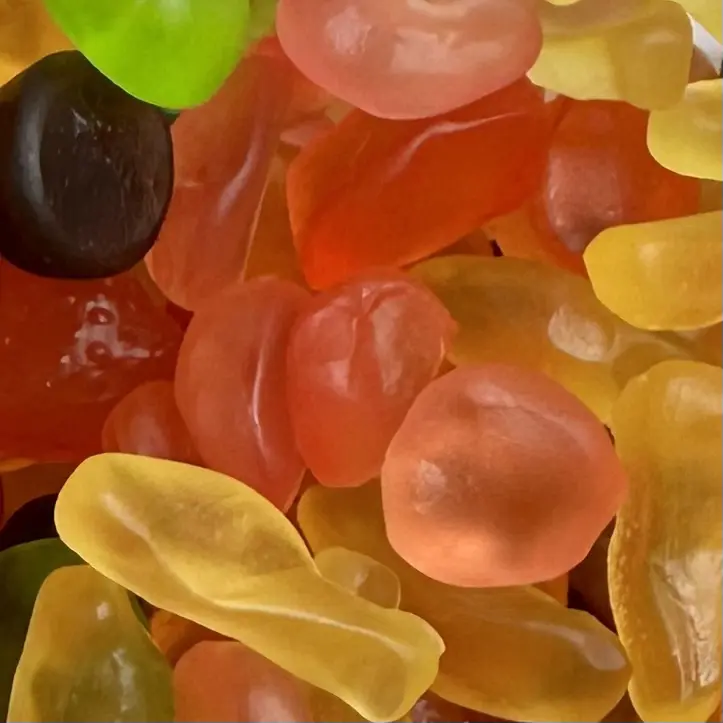
Mixed Peelable Gummy
7. Popular Peelable Gummy Shapes
Fruit-Shaped Gummies
Fruit shapes are among the most recognizable peelable gummy formats.
Possible concepts include:
- Mango
- Watermelon
- Strawberry
- Banana
- Grape
- Peach
- Lychee
- Lemon
- Orange
Character and Novelty Shapes
Custom molds can transform the same basic concept into characters, animals, seasonal products, or brand-specific shapes.
This can be particularly useful for promotional campaigns and limited-edition launches.
Custom Shapes for Private Label Brands
For custom peelable gummies, buyers can discuss:
- Shape
- Size
- Weight
- Color
- Flavor
- Layer structure
- Packaging
- Logo
- Seasonal theme
The more complex the mold, the more important it becomes to confirm tooling requirements, production feasibility, and sample approval before mass production.
8. Peelable Gummy vs. 3D Gummy vs. Traditional Gummy
The three categories can serve different product strategies.
| Product | Main Differentiator | Texture | Interaction | Typical Commercial Focus |
|---|---|---|---|---|
| Traditional Gummy | Flavor and chew | Usually uniform | Low | Everyday candy |
| 3D Gummy | Three-dimensional shape | Usually integrated | Medium | Visual novelty |
| Peelable Gummy | Peelable outer layer | Multi-texture | High | Interactive candy |
| 3D Peelable Gummy | Shape + peeling | Multi-texture | High | Premium novelty |
For buyers, the decision should depend on the desired consumer experience.
A retailer looking for a visually recognizable fruit product may prefer 3D or fruit-shaped gummies. A brand looking for a stronger interactive element may consider peelable gummies.
9. Why Are Peelable Gummies Becoming Popular?
Interactive Snacking
Consumers do not experience a peelable gummy only through taste.
They interact with it physically before eating it.
That additional action gives the product a distinctive identity.
Visual and Sensory Appeal
A realistic fruit appearance can make a product stand out on a crowded candy shelf.
When the peeling action is visible in product videos, the product can also demonstrate its uniqueness without requiring a long explanation.
Social Media and Short-Form Video
The visual nature of peeling lends itself naturally to short videos.
A product that can be understood within a few seconds has an advantage in visual content marketing because the product demonstration becomes part of the marketing material.
Novelty Candy Trends
The confectionery category continues to develop beyond conventional flavor-based differentiation.
Texture, shape, interactive experiences, surprise formats, and packaging can all become product differentiators.
For B2B buyers, this means peelable gummies can be considered as part of a broader novelty and experiential candy strategy.
10. Peelable Gummy Packaging Guide
Stand-Up Pouches
Stand-up pouches are suitable for many retail applications because they provide a large printable surface and can support resealable formats.
For fruit-shaped products, packaging should also provide sufficient protection against compression and deformation.
Individual Packaging
Individually wrapped pieces can be useful for:
- Convenience stores
- Party candy
- Promotional products
- Gift packs
- Event distribution
Multi-Pack Retail Packaging
Multi-flavor packs can combine several fruit shapes or flavors into one SKU.
This can help brands create a stronger visual assortment.
Resealable Packaging
Resealable pouches can be useful when consumers do not consume the entire pack in one sitting.
The packaging should protect the product from moisture exchange and excessive environmental exposure.
Packaging Design for Online Retail
E-commerce packaging needs additional consideration because the product may experience:
- Longer transportation
- Temperature variation
- Compression
- Repeated handling
- Higher exposure to vibration
Therefore, packaging should be evaluated together with the gummy formulation rather than treated as a separate design step.
11. Peelable Gummy OEM and Private Label
A successful Peelable Gummy OEM project starts with a clear product specification.
Buyers may customize:
- Flavor
- Shape
- Color
- Size
- Weight
- Texture
- Outer layer
- Center filling or flavor
- Packaging
- Artwork
- Carton configuration
A manufacturer with integrated product development can help turn a concept into a manufacturable specification.
For example, a retailer might start with the idea of “mango peelable gummies” and then define the final product through shape, color, flavor strength, piece weight, packaging, and shelf-life requirements.
OEM Development Process
A typical workflow can look like:
Concept → Formula Discussion → Shape Selection → Sample Development → Testing → Packaging Artwork → Pre-Production Approval → Mass Production → Inspection → Shipment
This process reduces the risk of moving directly from an idea to a large commercial order without validating the product.
12. How to Choose a Peelable Gummy Manufacturer
Choosing a supplier should involve more than comparing unit prices.
A suitable Peelable Gummy Manufacturer should be evaluated across product development, production, food safety, quality control, export capability, packaging, and communication.
For example, a buyer can review the manufacturer’s production background, customization capability, product portfolio, export experience, and quality management approach through its company information. Candy-Food provides an overview of its confectionery manufacturing and customization capabilities on its candy manufacturer company profile.
Product Development Capability
Ask whether the manufacturer can develop new flavors, shapes, textures, and packaging formats.
Manufacturing Capacity
Capacity matters when a product moves from sample stage to commercial scale.
The manufacturer should be able to explain production scheduling, minimum order requirements, and expected lead times.
Food Safety Management
Food safety systems should be part of the supplier evaluation process.
Codex describes HACCP as a science-based and systematic approach for identifying hazards and establishing controls. This makes process-based food safety management particularly relevant when evaluating an international confectionery supplier.
Quality Control
Ask how the supplier checks:
- Incoming materials
- Production parameters
- Finished product
- Weight
- Appearance
- Packaging
- Microbiological or other applicable safety parameters
- Batch traceability
Export Experience
International candy buyers should also consider whether the supplier understands export documentation, destination-market requirements, shipping conditions, and packaging specifications.
OEM and Private Label Experience
A manufacturer that regularly handles OEM projects may already have processes for:
- Artwork review
- Sampling
- Mold development
- Formula adjustment
- Packaging coordination
- Production approval
- Export documentation
13. Peelable Gummy Wholesale: What Buyers Should Check
When purchasing Peelable Gummy Wholesale, buyers should establish commercial specifications before comparing quotations.
MOQ
MOQ can vary according to flavor, packaging, mold, and customization requirements.
Do not evaluate MOQ independently from the total project.
A lower MOQ may be useful for market testing, while a larger MOQ may be appropriate for established retail distribution.
Product Weight and Pieces per Bag
Confirm:
- Net weight
- Approximate piece count
- Piece weight
- Weight tolerance
- Packaging configuration
These details affect retail pricing and logistics calculations.
Packaging Format
Confirm whether the product will be packed as:
- Bulk candy
- Individual bags
- Retail pouches
- Gift boxes
- Multi-flavor packs
- Custom private-label packaging
Shelf Life and Storage
Ask for the manufacturer’s stated shelf life and recommended storage conditions.
The shelf-life target should be validated for the actual commercial formulation and packaging combination.
Production Lead Time
Lead time can include:
- Sample development
- Mold preparation
- Formula approval
- Artwork approval
- Packaging production
- Manufacturing
- Inspection
- Export preparation
Shipping and Export Documents
International buyers may need documentation such as commercial invoices, packing lists, certificates, product specifications, and other documents depending on the destination and transaction.
Sample Approval
Never rely only on photographs.
For a peelable product, physical samples allow buyers to evaluate the most important attributes:
appearance + peeling + texture + flavor + packaging.
14. Quality Control Checklist for Peelable Gummies
A practical QC checklist should include both conventional confectionery quality and peelability.
| QC Item | What Buyers Should Check |
|---|---|
| Appearance | Clean, consistent surface |
| Shape | Accurate and stable |
| Color | Consistent between pieces |
| Weight | Within agreed specification |
| Texture | Consistent chew |
| Peeling | Outer layer separates as intended |
| Flavor | Consistent and appropriate intensity |
| Surface | No excessive sticking or defects |
| Packaging | Proper seal and print |
| Batch | Traceable production information |
| Shelf life | Suitable for intended distribution |
| Storage | Clearly specified conditions |
For large orders, buyers can also agree on inspection standards before production begins.
This creates a shared reference between buyer and manufacturer rather than relying on subjective expectations after production.
15. Peelable Gummy Shelf Life and Storage
Shelf life is influenced by formulation, packaging, water activity, temperature, humidity, oxygen exposure, and handling conditions.
Temperature
Excessive heat can affect gummy texture and shape.
During international transportation, temperature exposure should therefore be considered when selecting packaging and shipping arrangements.
Humidity
Gummies can exchange moisture with their environment.
High humidity may contribute to surface stickiness or texture changes, while inappropriate moisture loss can also affect chew characteristics.
Packaging Protection
A suitable package should protect the product from environmental exposure while maintaining the intended retail appearance.
Transportation Conditions
The commercial shelf-life target should consider the entire distribution chain:
Factory → Warehouse → Container → Importer → Distribution Center → Retail Store → Consumer
A product specification that works in the factory may need additional validation under real transportation conditions.
16. Regulatory and Labeling Considerations for Global Buyers
Regulatory requirements vary by destination market, so buyers should confirm requirements before finalizing packaging artwork.
Ingredient Declaration
The ingredient list should accurately reflect the commercial formula.
Allergen Information
For the U.S. market, FDA recognizes nine major food allergens: milk, eggs, fish, crustacean shellfish, tree nuts, peanuts, wheat, soybeans, and sesame. Sesame became the ninth major allergen effective January 1, 2023.
This is particularly relevant when developing gummy products containing ingredients or processing inputs that may trigger allergen-labeling requirements.
Nutrition Information
Nutrition labeling requirements depend on the destination market and product category.
Net Weight
Retail packaging should display the appropriate net quantity according to applicable market requirements.
Date Marking and Storage
Depending on the destination, packaging may need appropriate date-marking and storage information.
Country-Specific Requirements
A product sold in the United States may require different labeling treatment from one sold in the European Union, Middle East, Southeast Asia, or another market.
Therefore, international buyers should confirm the exact requirements before approving final packaging.
17. Where Can Peelable Gummy Candy Be Sold?
Peelable gummies can fit multiple retail channels.
Supermarkets
Supermarkets can use peelable gummies as novelty candy, children’s confectionery, seasonal products, or premium impulse items.
Convenience Stores
Small bags and recognizable fruit shapes can work well in convenience-oriented retail environments.
Candy Shops
Specialty candy stores can use interactive products to create a differentiated assortment.
Online Retail
E-commerce allows brands to demonstrate peeling performance through product videos.
Gift Shops and Party Candy
Colorful fruit shapes and novelty designs can work well for party bags, events, and gift assortments.
Seasonal Candy
Custom shapes and packaging can be developed around:
- Halloween
- Christmas
- Easter
- Valentine’s Day
- Summer promotions
- Regional festivals
18. Peelable Gummy Candy for Different Markets
A global product strategy should avoid assuming that every market has exactly the same preferences.
North America
Visual novelty, convenience formats, online discovery, and interactive product demonstrations can be relevant considerations.
Europe
Buyers may place additional emphasis on ingredient transparency, labeling, food safety documentation, and packaging requirements.
Middle East
Packaging appearance, gifting applications, halal considerations where relevant, and premium presentation can influence product selection.
Southeast Asia
Fruit flavors, colorful designs, novelty formats, and competitive price positioning can be relevant to product development.
Latin America
Fruit-forward flavor concepts and visually attractive retail packaging may provide opportunities, while local regulatory and distribution requirements should be evaluated separately.
The best approach is to adapt the same core product platform rather than assuming one universal SKU will suit every market.
19. Common Mistakes When Buying Peelable Gummies
Choosing Only by Price
The lowest quotation does not necessarily represent the lowest total procurement cost.
Buyers should consider:
unit cost + packaging + MOQ + quality + shipping + shelf stability + rejected-product risk.
Ignoring Peeling Performance
A peelable gummy needs to peel.
This should be tested directly during sample approval.
Not Testing Samples
Photographs cannot show actual texture, elasticity, adhesion, flavor, or peeling behavior.
Overlooking Packaging
A good gummy can lose commercial quality if packaging does not adequately protect it during transportation.
Ignoring Shelf-Life Conditions
Shelf life should be considered together with the target distribution environment.
Not Confirming Label Requirements
Packaging artwork should not be finalized before the destination-market requirements have been reviewed.
Not Checking OEM Capabilities
If the product requires custom molds, special colors, private-label packaging, or multiple flavors, the supplier’s development capabilities should be confirmed early.
20. Peelable Gummy Candy Market Trends
Fruit-Shaped Interactive Candy
Fruit-shaped products remain attractive because they communicate flavor and product concept visually.
Premium Visual Design
Packaging and product appearance are increasingly important in novelty confectionery.
Smaller Convenience Packs
Smaller packs can support trial purchases, impulse retail, and convenience channels.
Blind-Box and Surprise Formats
A peelable structure can be combined with surprise flavors, mixed assortments, or blind-box concepts.
This creates another layer of interaction beyond peeling.
3D and Peelable Gummy Combinations
Combining three-dimensional shapes with a peelable structure can increase product differentiation.
Seasonal Peelable Gummies
Seasonal molds and packaging provide opportunities for limited-edition product launches.
Custom Private Label Products
Private-label development allows distributors and retailers to create differentiated products instead of competing only on existing branded SKUs.
Peelable Gummy
21. How to Select the Right Peelable Gummy for Your Brand
The final product should be selected through a structured decision process.
Step 1: Define the Target Consumer
Identify who will buy and consume the product.
Step 2: Select the Flavor Family
Choose flavors that match the target market and brand positioning.
Step 3: Select the Shape
Fruit shapes offer immediate recognition, while custom shapes can create stronger brand differentiation.
Step 4: Define Texture and Peeling Requirements
Specify how the product should feel and how the outer layer should separate.
Step 5: Choose Packaging
Consider retail shelf appearance, transportation, resealing, and moisture protection.
Step 6: Request Samples
Evaluate the actual product rather than relying only on specifications.
Step 7: Test Stability
Confirm the product’s behavior under intended storage and transportation conditions.
Step 8: Confirm MOQ and Lead Time
Make sure the commercial requirements fit the launch plan.
Step 9: Approve Artwork
Review all product claims, ingredients, allergen information, nutrition information, net weight, dates, and other required labeling before production.
Step 10: Start Mass Production
Once the product, packaging, specifications, and quality requirements are approved, the manufacturer can proceed to commercial production.
For buyers ready to discuss specifications, samples, packaging, or OEM development, the manufacturer’s contact and inquiry page can be used to begin the project discussion.
22. Frequently Asked Questions About Peelable Gummies
1. What are peelable gummies?
Peelable gummies are chewy confectionery products designed with a removable outer layer and an inner gummy center. Unlike traditional gummies, they provide an interactive eating experience because consumers can physically peel away the outer layer before eating the center. Many products use fruit-inspired shapes and flavors such as mango, strawberry, grape, peach, banana, lychee, and watermelon. For commercial buyers, peelability, texture, shape retention, flavor consistency, packaging, and shelf stability are important quality considerations.
2. How are peelable gummies made?
Peelable gummies are typically developed using multiple formulation and processing stages rather than a conventional single-layer gummy process. Ingredients are prepared according to the desired texture, flavor, and structure. The outer and inner components are then formed into the intended shape using controlled manufacturing processes. Cooling and setting help stabilize the product, followed by demolding, surface treatment, inspection, and packaging. The exact process depends on the formulation, equipment, shape, and desired peeling performance.
3. What makes peelable gummies different from regular gummies?
The primary difference is product structure and consumer interaction. Regular gummies are generally designed to be eaten as an integrated piece, while peelable gummies have an outer layer that can be separated from the center. This creates a multi-texture experience involving peeling, revealing, and eating. Peelable gummies can also use realistic fruit shapes, custom colors, multiple flavors, and specialized packaging, making them particularly suitable for novelty candy, private-label products, retail promotions, and interactive confectionery concepts.
4. What are the most popular peelable gummy flavors?
Common peelable gummy flavor concepts include mango, strawberry, grape, peach, white peach, banana, lychee, watermelon, and mixed fruit. Fruit-shaped products often match the visual appearance of their flavor, such as a mango-shaped gummy with mango flavor or a strawberry-shaped gummy with strawberry flavor. However, the best flavor depends on the target country, consumer group, retail channel, product positioning, and price point. Buyers can also develop custom flavor combinations through an OEM project.
5. Can peelable gummies be customized for private-label brands?
Yes. Private-label peelable gummies can potentially be customized in several areas, including flavor, shape, color, size, piece weight, texture, outer-layer characteristics, packaging, artwork, and carton configuration. Buyers should discuss their target market, product specifications, MOQ, mold requirements, shelf-life expectations, packaging format, and regulatory requirements with the manufacturer before mass production. A structured sample-development process is recommended so that peeling performance and final product quality can be evaluated before a commercial order.
23.Why Peelable Gummies Are More Than a Novelty Candy
Peelable gummies combine several elements that are valuable in modern confectionery: recognizable fruit shapes, multi-texture eating, interactive behavior, visual differentiation, and customization potential.
For consumers, the key attraction is simple: the product is fun to peel and eat.
For B2B buyers, however, the product requires a much broader evaluation.
A commercially successful Peelable Gummy needs the right formulation, controlled peeling performance, consistent texture, attractive shape, reliable packaging, stable shelf life, appropriate labeling, and dependable manufacturing.
For wholesalers, the focus should be on product consistency, MOQ, packaging, lead time, documentation, and total procurement value.
For private-label brands, the opportunity is broader because the product can be customized around flavor, shape, color, packaging, and brand identity.
For manufacturers, the technical challenge is balancing the outer layer and inner center so that the final product delivers the intended peeling experience while remaining stable throughout production and distribution.
For buyers searching for a ready-to-develop product range, Candy-Food’s Peelable Gummy product collection provides a starting point for reviewing product concepts, while its dedicated guide on choosing a reliable peelable gummy partner in China can help structure the supplier-evaluation process.
The key decision is therefore not simply whether peelable gummies look attractive. It is whether the product, manufacturer, packaging, quality system, and commercial specification work together for the intended market.
Feature Product
-
 Gummy Candy
What Is Gummy Candy? Gummy Candy is one of the ...
-
 Crispy Gummy Candy
What Is Crispy Gummy Candy Crispy Gummy Candy i...
-
 Peelable Gummy Candy
What Is Peelable Gummy Candy? Peelable Gummy Ca...