

Easter is one of the most visually recognizable seasonal candy occasions, but successful seasonal confectionery is not created simply by putting a bunny or egg graphic on a standard package. For B2B buyers, the more important question is whether the product can create a clear retail identity while remaining practical to manufacture, pack, transport, label, and replenish.
This is why Easter Candy OEM has become an important development model for supermarkets, wholesalers, importers, distributors, e-commerce brands, gift companies, and private-label retailers. Instead of choosing only from an existing catalog, buyers can specify the shape, flavor profile, color system, texture, piece weight, packaging format, assortment, and branding direction.
For buyers evaluating a long-term manufacturing partner, understanding the factory’s capabilities is equally important. A confectionery manufacturer should ideally provide product development, production, quality control, customization, packaging coordination, and export support within one commercial workflow. For example, TOPHEART Food manufacturer describes its operation as covering production, research and development, customization, and export, with six production factories and a total area of 258,000 square meters. Its products are exported to more than 92 countries and regions.
The practical goal is therefore not simply to create attractive Easter candy. It is to build a product specification that connects consumer appeal with manufacturing feasibility and commercial performance.
Easter Candy
What Is Easter Candy OEM?
OEM means that a buyer develops a confectionery product with a manufacturer according to defined commercial and technical specifications. The finished product can be produced under the buyer’s own brand, private label, distributor label, or retail program.
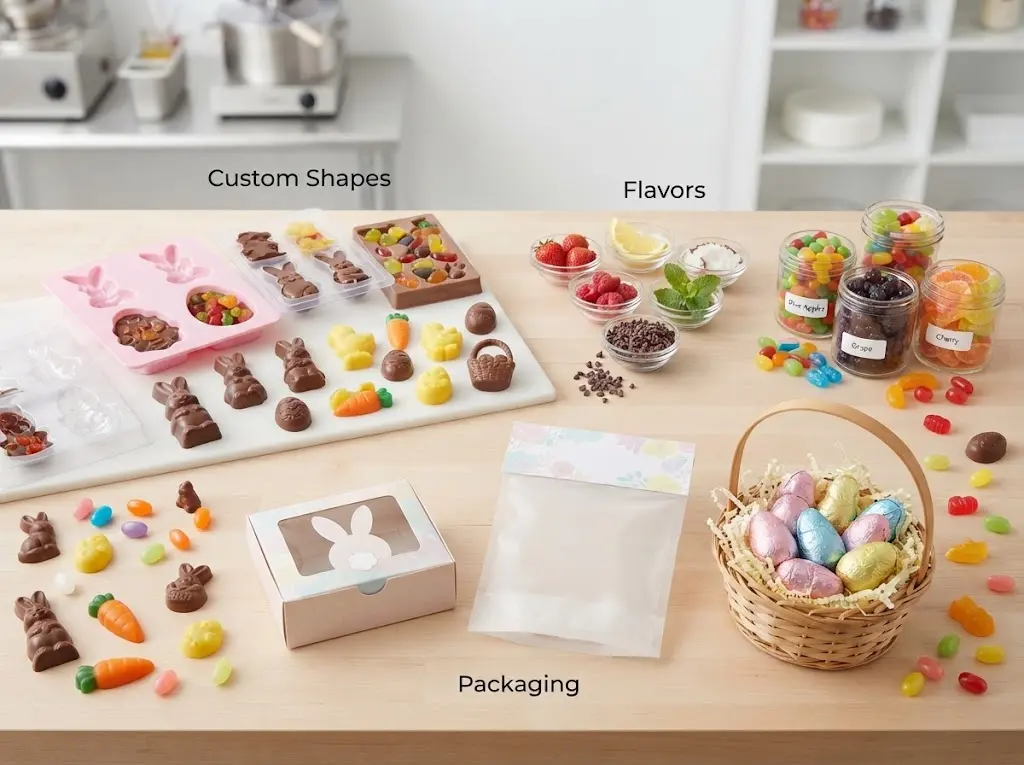
For Custom Easter Candy, customization can occur at several levels:
- Shape and mold design
- Flavor and flavor combinations
- Color and visual appearance
- Texture and chew characteristics
- Piece weight and pack weight
- Filling, coating, or sour components
- Packaging structure
- Artwork and brand identity
- Assortment and flavor mix
- Carton configuration
A standard seasonal product may provide speed and predictable manufacturing. An OEM product provides greater differentiation. The correct decision depends on the buyer’s sales channel, launch date, expected volume, budget structure, target market, and desired level of product uniqueness.
For a supermarket private-label program, packaging and shelf presentation may be the highest priorities. For an online gift brand, shape, visual novelty, and premium packaging may carry more commercial weight. For a wholesale distributor, consistent specifications, carton efficiency, production capacity, and repeatability can become more important.
Which Easter Candy Products Can Be Customized?
Custom Easter Gummy Candy
Gummies are particularly suitable for seasonal customization because their shape, color, flavor, size, and texture can be adjusted through the manufacturing process. Common Easter concepts include eggs, rabbits, chicks, lambs, carrots, flowers, baskets, spring animals, and multi-character assortments.
For buyers searching for custom Easter gummies, the product specification should go beyond appearance. A manufacturer should understand the desired piece weight, mold detail, flavor intensity, sweetness-to-acidity balance, texture, surface finish, and packaging environment.
Three-dimensional and four-dimensional gummies can also create stronger visual differentiation. The existing Easter range from TOPHEART includes carrot gummies, jelly beans, carrot-shaped jelly beans, building gummy cubes, puzzle gummy blocks, and other seasonal formats.
Custom Easter Chocolate
Chocolate Easter products can include molded eggs, rabbits, filled pieces, mixed chocolate assortments, foil-wrapped pieces, gift boxes, and seasonal combinations. Chocolate requires additional attention to temperature management, fat bloom, filling compatibility, packaging protection, and transport conditions.
For premium retailers, the packaging and presentation can be developed together with the chocolate form so that the final product looks intentional rather than simply seasonal.
Custom Easter Hard Candy and Lollipops
Hard candy can be customized through shape, color, flavor, transparency, layering, wrapping, and promotional presentation. Individually wrapped pieces are useful for party distribution, sampling, events, and high-frequency retail environments.
Custom Easter Marshmallow Candy
Marshmallows can use Easter-specific forms such as chicks, rabbits, flowers, eggs, or seasonal characters. Pastel colors and soft textures can support spring-oriented merchandising, while multipacks and gift packaging can increase their suitability for seasonal gifting.
How to Customize Easter Candy Shapes
Shape customization usually follows a structured development sequence:
Concept → 2D drawing → 3D model → mold development → prototype → sample approval → production mold → mass production.
The earlier the buyer defines technical dimensions, the easier it becomes to control cost, packaging fit, production yield, and consistency.
| Shape Parameter | Typical Buyer Decision | Commercial Impact |
|---|---|---|
| Length | Approx. 15–40 mm for many small-format pieces | Influences visual recognition and pack count |
| Width | Approx. 10–35 mm | Affects mold layout and packaging density |
| Thickness | Approx. 5–20 mm | Influences bite, drying, cooling, and appearance |
| Piece weight | Defined by product and pack architecture | Controls count per bag and net-weight consistency |
| Cavity count | Determined by mold design | Influences production efficiency |
| Surface detail | Low, medium, or high detail | Determines mold complexity and visual differentiation |
These ranges are development examples rather than universal manufacturing standards. The final specification should be established through sample testing because shape geometry interacts with formulation, drying, demolding, packaging, and transportation.
How to Customize Easter Candy Flavors
Flavor customization should be treated as a measurable product specification rather than a simple request such as “make it fruity.” A buyer should define the flavor family, sweetness level, acidity, aroma intensity, color association, aftertaste, and whether multiple flavors will be combined in one package.
| Flavor Direction | Typical Easter Application | Customization Consideration |
|---|---|---|
| Strawberry | Pink gummies and marshmallows | Sweet berry aroma and pastel visual identity |
| Lemon | Yellow seasonal candy | Higher acidity can increase freshness perception |
| Orange | Orange and carrot concepts | Works well with bright spring colors |
| Mango | Tropical seasonal assortments | Strong aroma and fruit-forward positioning |
| Peach | Soft pastel products | Useful for delicate fruit profiles |
| Mixed fruit | Multi-color Easter bags | Supports variety without excessive individual SKUs |
For wholesale buyers, flavor architecture should also be connected to SKU management. Five flavors can sound attractive during product development, but if each flavor requires a separate mold, artwork, packaging plate, and production schedule, the operational complexity can increase significantly.
How Easter Candy Texture Is Customized
Texture is one of the most technical aspects of gummy development. It can be influenced by hydrocolloid type, hydrocolloid concentration, gelatin characteristics, pectin system, soluble solids, acidity, processing temperature, moisture, drying conditions, and storage environment.
Published research demonstrates why texture should be developed scientifically rather than evaluated only by visual appearance. DeMars and Ziegler studied gelatin and high-methoxyl pectin gummy systems using 3.0%, 4.5%, and 6.0% gelatin with 0%, 0.5%, 1.0%, and 1.5% high-methoxyl pectin in the experimental formulations. The research found measurable relationships between instrumental fracture properties and sensory texture.
| Scientific Variable | Example Published Range or Finding | Why It Matters |
|---|---|---|
| Gelatin concentration | 3.0–6.0% in the cited experimental gummy system | Influences gel strength and bite |
| High-methoxyl pectin | 0–1.5% in the cited experimental system | Changes gel structure and fracture behavior |
| Sucrose | 33.4% in the cited formulation | Contributes to solids and sensory profile |
| Corn syrup solids | 29.8% in the cited formulation | Contributes to solids and texture |
| Gelatin in another study | 4–6% | Studied in concentrated sugar systems |
| Total sweetener solids | Approximately 70–80% in the 2022 study | Strongly affects gelation and texture behavior |
The values above are published experimental formulations, not universal commercial recipes. Wang and Hartel found that gelatin gel rheology and texture were influenced by both gelation and glass-transition behavior, while surface tackiness showed a strong relationship with hardness in the tested systems.
Acid management is also important. Research on confectionery gels indicates that acid and heat treatment can affect gelatin hydrolysis and gel strength, while excessive thermal treatment can contribute to sugar inversion and browning.
For buyers, this means “soft,” “chewy,” “firm,” “bouncy,” or “juicy” should be converted into measurable sample criteria before approval.
How Easter Candy Color Is Customized
Easter naturally supports pastel color systems such as pink, yellow, light green, lavender, blue, white, and orange. However, color should be selected according to the destination market, ingredient declaration requirements, formulation stability, and packaging appearance.
A common commercial mistake is to approve color only under factory lighting. The final appearance should also be evaluated after packaging because transparent film, printed pouches, reflective materials, and different lighting environments can change visual perception.
A practical approval system can define three levels:
- Primary brand color
- Secondary seasonal color
- Accent color for flavor or character identification
This approach allows a single Easter collection to look unified while still communicating different flavors.
How to Build Easter Candy Packaging
Packaging is not an afterthought in seasonal OEM. It influences shelf visibility, transportation efficiency, product protection, consumer perception, and the number of pieces that can be packed into each retail unit.
Common Easter Candy Packaging formats include resealable pouches, pillow bags, jars, display boxes, gift boxes, individual wrappers, hanging bags, multipacks, and mixed assortments.
A seasonal candy supplier can support multiple festive categories through packaging and theme customization. TOPHEART’s broader festive range includes seasonal gummies, marshmallows, hard candies, lollipops, chocolates, and other confectionery formats, positioning seasonal products as a wider retail program rather than a single SKU.
| Packaging Format | Best-Fit Channel | Main Commercial Advantage |
|---|---|---|
| Resealable pouch | Supermarkets and e-commerce | Convenience and repeat consumption |
| Individual wrapper | Parties, events, sampling | Controlled portioning and hygiene |
| Display box | Retail counters | Strong merchandising visibility |
| Gift box | Premium and gifting | Higher perceived presentation value |
| Jar | Specialty retail and bulk | High visual product density |
| Mixed assortment | Seasonal promotions | Multiple shapes and flavors in one SKU |
How to Develop Private Label Easter Candy
A private-label project should begin with a commercial product brief rather than artwork. The recommended specification includes:
- Target consumer
- Sales channel
- Product category
- Shape
- Piece weight
- Flavor
- Color
- Texture
- Net weight
- Pieces per package
- Packaging format
- Carton quantity
- Artwork requirements
- Destination market
- Labeling requirements
- Expected order volume
- Target launch date
The development workflow can then follow:
Market brief → product concept → formula and shape development → sample → buyer evaluation → artwork → compliance review → mass production → quality control → shipment.
This sequence reduces the risk of designing packaging around a product specification that later changes.
How Much Does Easter Candy OEM Cost?
For B2B buyers, the most useful approach is to analyze cost drivers instead of focusing only on a quoted unit price. OEM cost can be influenced by:
- Ingredient system
- Product weight
- Formula complexity
- Custom mold development
- Number of flavors
- Number of SKUs
- Packaging material
- Printing requirements
- Individual wrapping
- Gift-box construction
- Order volume
- Production scheduling
- Inspection requirements
- Shipping configuration
A useful commercial model is:
Total landed cost = product cost + packaging cost + tooling allocation + inspection cost + logistics cost + applicable duties and market-specific expenses.
This is particularly important when comparing an Easter Candy factory with a trading company. The lowest quoted product price does not necessarily represent the lowest total procurement cost once packaging, quality consistency, communication, tooling, and logistics are considered.
MOQ and Lead Time for Easter Candy OEM
MOQ is not a single universal number for all Easter candy projects. It depends on the production line, product type, packaging format, mold investment, flavor count, packaging material, and production schedule.
For seasonal candy, timing is especially important because Easter demand is concentrated within a limited retail window. Buyers should reverse-plan from the required delivery date instead of starting from the desired production date.
A practical planning sequence is:
| Stage | Planning Question |
|---|---|
| Market research | What product should be launched? |
| Product development | Can the shape and formula be finalized? |
| Sampling | Has the buyer approved texture, flavor, and appearance? |
| Packaging | Has artwork and packaging structure been approved? |
| Compliance | Is the label suitable for the destination market? |
| Production | Is factory capacity reserved? |
| Logistics | Is sufficient time available for transportation and customs? |
For buyers that need customized molds and packaging, earlier development generally provides more room for sampling, corrections, artwork adjustments, and production scheduling.
Easter Candy Shelf Life and Storage
Shelf life depends on product formulation and packaging rather than a single fixed number. For gummies, moisture migration and water activity can influence texture. For chocolate, temperature and fat stability are particularly important. For hard candy, moisture absorption can influence stickiness and surface appearance.
Packaging should therefore be evaluated together with the product:
| Risk Factor | Potential Effect | Control Direction |
|---|---|---|
| High humidity | Surface stickiness | Appropriate moisture-barrier packaging |
| High temperature | Texture change or chocolate instability | Temperature-controlled logistics where appropriate |
| Oxygen | Flavor or fat oxidation | Suitable barrier materials |
| Light | Color or flavor deterioration | Light-resistant packaging where required |
| Moisture migration | Texture change | Formulation and packaging compatibility |
Research on gelatin gel stability has also shown that higher-Bloom gelatin can provide greater storage stability under certain conditions, while elevated temperatures can degrade gelatin and affect mechanical properties.
Food Safety and Labeling Requirements for Easter Candy
Regulatory requirements depend on the destination market. Buyers should therefore determine the target country before finalizing the commercial artwork.
United States
For the United States, ingredient declaration and allergen labeling are important components of packaged food compliance. FDA guidance explains requirements associated with major food allergens and ingredient declaration. Sesame is included among the major food allergens under current United States requirements.
Other considerations may include nutrition labeling, net quantity, manufacturer or distributor information, color additive requirements, claims, and applicable product-specific rules.
European Union
For the European Union, Regulation (EU) No 1169/2011 establishes requirements for food information to consumers. For prepacked foods, mandatory information includes the name of the food, ingredients, allergens, net quantity, date marking, storage conditions where applicable, responsible food business operator information, origin where required, instructions where necessary, and nutrition information.
The European Commission also emphasizes that allergen information must be clearly distinguished within the ingredient list, and EU rules cover 14 specified allergen categories.
For online selling, mandatory food information also needs to be available before the purchase is concluded in relevant distance-selling situations.
For this reason, product artwork should not be treated as the final compliance document until ingredients, allergens, nutrition data, claims, translations, and destination-market requirements have been reviewed.
How to Choose an Easter Candy Manufacturer
Choosing an Easter Candy manufacturer should be based on manufacturing capability rather than product photos alone.
Buyers should evaluate at least these ten factors:
- Experience with seasonal confectionery
- Custom mold development capability
- Flavor and formula development
- Packaging customization
- Production capacity
- Quality control procedures
- Food safety management
- Sample development process
- Export and documentation experience
- Communication and delivery planning
Manufacturing scale is particularly relevant for seasonal projects because production must often be completed within a concentrated time window. A factory’s stated production capacity, inspection resources, product categories, and export experience should therefore be reviewed as part of supplier qualification.
For buyers ready to discuss a product specification, packaging requirement, sample, or private-label project, the manufacturer’s direct project channel is useful for moving from general product interest to a concrete specification.
Real-World Easter Candy OEM Scenarios
Supermarket Private Label
A supermarket may want a 150–250 gram resealable Easter pouch containing several seasonal shapes. The commercial priority is usually recognizable shapes, attractive packaging, consistent weight, clear labeling, and efficient carton configuration.
European Gummy Brand
A European gummy brand may request pectin-based development, pastel colors, rabbit or egg shapes, fruit flavors, and packaging adapted to EU labeling requirements. The key decision is not simply “gelatin or pectin,” but which formulation provides the required texture, positioning, label profile, and supply consistency.
United States Party Supplier
A party supplier may prioritize individually wrapped pieces, multiple Easter shapes, mixed colors, and bulk cartons. Here, piece consistency and wrapping efficiency can be more important than premium gift-box presentation.
E-Commerce Gift Brand
An online gift brand may prefer a premium box containing multiple gummy characters, Easter-themed artwork, and a visually distinctive assortment. In this case, packaging engineering and product photography requirements should be considered at the beginning of development.
A Product Example: 4D Easter Character Gummies
A useful example of how seasonal product development can move beyond conventional eggs is a multi-character 4D gummy assortment. The current product concept combines lamb, bunny, and chick shapes with mixed fruit flavors, natural colors, gelatin, and a resealable 150 gram bag.
This type of product demonstrates an important OEM principle: the seasonal theme can be embedded directly into the candy rather than existing only on the packaging.
For a buyer, the same concept could potentially be adapted through shape combinations, flavor profiles, colors, pack weights, artwork, assortment ratios, or packaging structures depending on the target market.
For buyers specifically evaluating Easter 4D Lamb Bunny Chick Gummies as a reference product or development direction, the existing product page provides a useful example of how Easter characters can be combined into a single seasonal gummy concept.
Common Easter Candy OEM Mistakes
Ordering Too Late
Seasonal production has a fixed commercial deadline. Starting late can reduce the available time for mold development, sampling, packaging correction, compliance review, and logistics.
Designing Packaging Before Product Approval
Packaging dimensions depend on product geometry, piece count, weight, headspace, sealing requirements, and product protection. Final artwork should therefore be synchronized with the approved product specification.
Launching Too Many Flavors
Flavor variety can increase consumer appeal, but every additional flavor may introduce additional formulation, procurement, production, quality-control, and inventory considerations.
Skipping Sample Approval
A product can look correct in a digital rendering but perform differently in texture, flavor, color, weight, or packaging. Physical sample approval should therefore be a defined commercial milestone.
Comparing Suppliers Only by Unit Price
A better comparison evaluates total procurement value: product quality, consistency, tooling, packaging, documentation, communication, production capacity, lead time, logistics coordination, and repeat-order capability.
Easter Candy OEM Quality Control Checklist
| Control Stage | Buyer Check |
|---|---|
| Raw materials | Approved ingredients and specifications |
| Production | Process consistency and batch records |
| Shape | Dimensional and visual consistency |
| Weight | Piece and finished-pack consistency |
| Texture | Sample-to-production consistency |
| Flavor | Approved sensory profile |
| Color | Approved reference standard |
| Packaging | Seal, print, structure, and count |
| Label | Ingredient and regulatory review |
| Finished goods | Final inspection and shipment approval |
Easter Candy OEM Buyer Decision Matrix
| Buyer Type | Primary Priority | Recommended OEM Level |
|---|---|---|
| Supermarket | Shelf visibility and repeatability | Custom packaging + selected custom shapes |
| Distributor | Volume and SKU efficiency | Standardized product + selective customization |
| Private-label brand | Brand differentiation | Shape + flavor + packaging |
| E-commerce brand | Visual novelty and gifting | Custom product + premium packaging |
| Premium retailer | Presentation and perceived value | Custom shapes + premium gift box |
| Party supplier | Portioning and convenience | Individually wrapped or bulk formats |
Easter Candy Industry Trends and Product Opportunities
Seasonal candy development is moving toward greater visual differentiation, interactive formats, premium presentation, and customization. Gummies are especially suitable for these trends because they can combine shape, color, texture, flavor, and packaging into one product concept.
The broader seasonal product category also demonstrates how manufacturers can develop Easter products alongside Christmas, Halloween, Valentine’s Day, and other occasions. This creates opportunities for retailers to build a complete seasonal candy calendar rather than treating Easter as an isolated purchase.
The dedicated Easter Candy supplier category from TOPHEART currently includes carrot gummies, jelly beans, carrot-shaped jelly beans, 4D lamb/bunny/chick gummies, building gummy cubes, and puzzle gummy blocks, illustrating the range of seasonal concepts that can be developed around shapes, interaction, and character-based presentation.
How to Select the Right Easter Candy OEM Partner
The best supplier is determined by project requirements rather than by a single universal ranking.
If speed is the main objective, a buyer can consider an existing candy shape with customized packaging. If differentiation is the priority, custom shape, flavor, color, and packaging can be developed together. If a plant-based positioning is required, pectin-based formulation may be evaluated. If premium gifting is the objective, a custom assortment and gift box may create stronger positioning.
High-volume buyers should pay particular attention to production capacity, packaging efficiency, raw-material availability, quality systems, and repeat-order consistency. Smaller brands may place greater emphasis on development support, communication, sampling flexibility, and manageable SKU architecture.
The strongest procurement decision therefore follows this logic:
Market → consumer → sales channel → product format → shape → formula → flavor → packaging → compliance → production → logistics → repeat order.
Final Takeaway: Design Easter Candy Around the Buyer, Not Just the Holiday
A successful Easter Candy OEM project is not simply a seasonal graphic exercise. It is a coordinated product-development process that connects consumer expectations with confectionery science, manufacturing capability, packaging engineering, food safety, regulatory compliance, and supply-chain planning.
For buyers, the most effective strategy is to decide the required level of customization before requesting quotations. A standard product with custom packaging may suit a fast seasonal launch. A custom shape may create stronger differentiation. A multi-flavor assortment can increase variety. A premium box can support gifting. A 3D or 4D gummy can turn the candy itself into a visual marketing asset.
The important point is that each option should be evaluated according to its commercial purpose. When product, packaging, compliance, production, and logistics are designed together, Easter Candy wholesale can become a repeatable seasonal business program rather than a one-time promotional purchase.
Frequently Asked Questions About Easter Candy OEM
1. What can be customized in Easter Candy OEM?
Easter Candy OEM can customize many parts of a confectionery product, including shape, mold design, flavor, color, texture, piece weight, net weight, assortment, filling, coating, packaging format, artwork, and carton configuration. For gummies, buyers can develop Easter-specific shapes such as eggs, rabbits, chicks, lambs, carrots, flowers, and other seasonal characters. Flavor customization can include strawberry, grape, mango, peach, lemon, orange, mixed fruit, berry, and sour fruit profiles. Packaging can range from resealable pouches and individual wrappers to display boxes and premium gift boxes. The practical level of customization depends on production technology, order volume, tooling requirements, packaging materials, and destination-market regulations.
2. How do I choose an Easter Candy manufacturer?
Choose an Easter Candy manufacturer by evaluating the complete supply chain rather than comparing only product photographs or unit prices. Important criteria include custom mold development, formulation capability, seasonal production capacity, packaging customization, quality control, food safety systems, sampling procedures, export experience, documentation, lead-time management, and communication. Buyers should also ask whether the supplier can support repeat production after the first Easter launch. A manufacturer capable of coordinating product development, packaging, compliance, production, inspection, and shipment can reduce communication gaps and make seasonal procurement easier to manage.
3. What is the MOQ for custom Easter Candy?
There is no universal MOQ for all custom Easter Candy projects because minimum order quantities depend on product type, mold requirements, packaging format, flavor count, production line, and order scheduling. A simple existing gummy shape with custom packaging may have a different commercial threshold from a completely new molded product requiring tooling and multiple flavors. Buyers should provide the intended product category, target weight, number of SKUs, packaging format, destination market, and estimated order volume when requesting an OEM quotation. This allows the manufacturer to determine a more realistic production plan instead of applying a generic MOQ.
4. How early should I order custom Easter Candy?
Custom Easter Candy should be planned well before the intended retail launch because seasonal projects can require several stages, including product concept development, mold design, sampling, formula adjustment, packaging artwork, compliance review, production scheduling, quality inspection, and logistics. The more customized the product, the more development time may be required. Buyers should work backward from the date when the goods need to arrive at a warehouse or distribution center. Allowing additional time for sample revisions and packaging corrections is especially useful because seasonal retail programs operate within a limited sales window.
5. Can I create private label Easter Candy with custom packaging?
Yes. Private label Easter Candy can combine an existing confectionery format or custom-developed product with customized branding and packaging. Depending on the project, a buyer can specify the candy shape, flavor, color, texture, pack weight, assortment, pouch or box structure, printed artwork, individual wrapping, and outer carton configuration. The packaging should be developed together with the approved product specification so that dimensions, piece count, net weight, sealing requirements, and protection needs are compatible. Before mass production, buyers should also verify the ingredient statement, allergen declaration, nutrition information, claims, language, and other requirements applicable to the destination market.
Feature Product
-
 Gummy Candy
What Is Gummy Candy? Gummy Candy is one of the ...
-
 Crispy Gummy Candy
What Is Crispy Gummy Candy Crispy Gummy Candy i...
-
 Peelable Gummy Candy
What Is Peelable Gummy Candy? Peelable Gummy Ca...