

From Coffee Flavor to a Scalable Confectionery Product
Coffee has long been associated with energy, comfort, social occasions, and premium taste. But consumers do not always want a full cup of coffee. A compact confectionery format can deliver a familiar coffee-inspired taste in a convenient, portable form, making Coffee Candy an interesting product category for retailers, importers, distributors, coffee brands, and private-label businesses.
For B2B buyers, the opportunity goes beyond simply purchasing finished candy. A successful product requires the right flavor profile, tablet specification, packaging format, quality controls, regulatory documentation, minimum order quantity, and manufacturing partner. This is particularly important when developing Pressed Coffee Candy, because compression-based confectionery requires consistent powder preparation, particle distribution, compression, and finished-product inspection.
For buyers evaluating a Coffee Candy Manufacturer, the most important question is therefore not simply “Who offers the lowest price?” It is “Which supplier can consistently deliver the specification, packaging, compliance, and commercial flexibility required for my market?”
Premium Coffee Candy
What Is Coffee Candy?
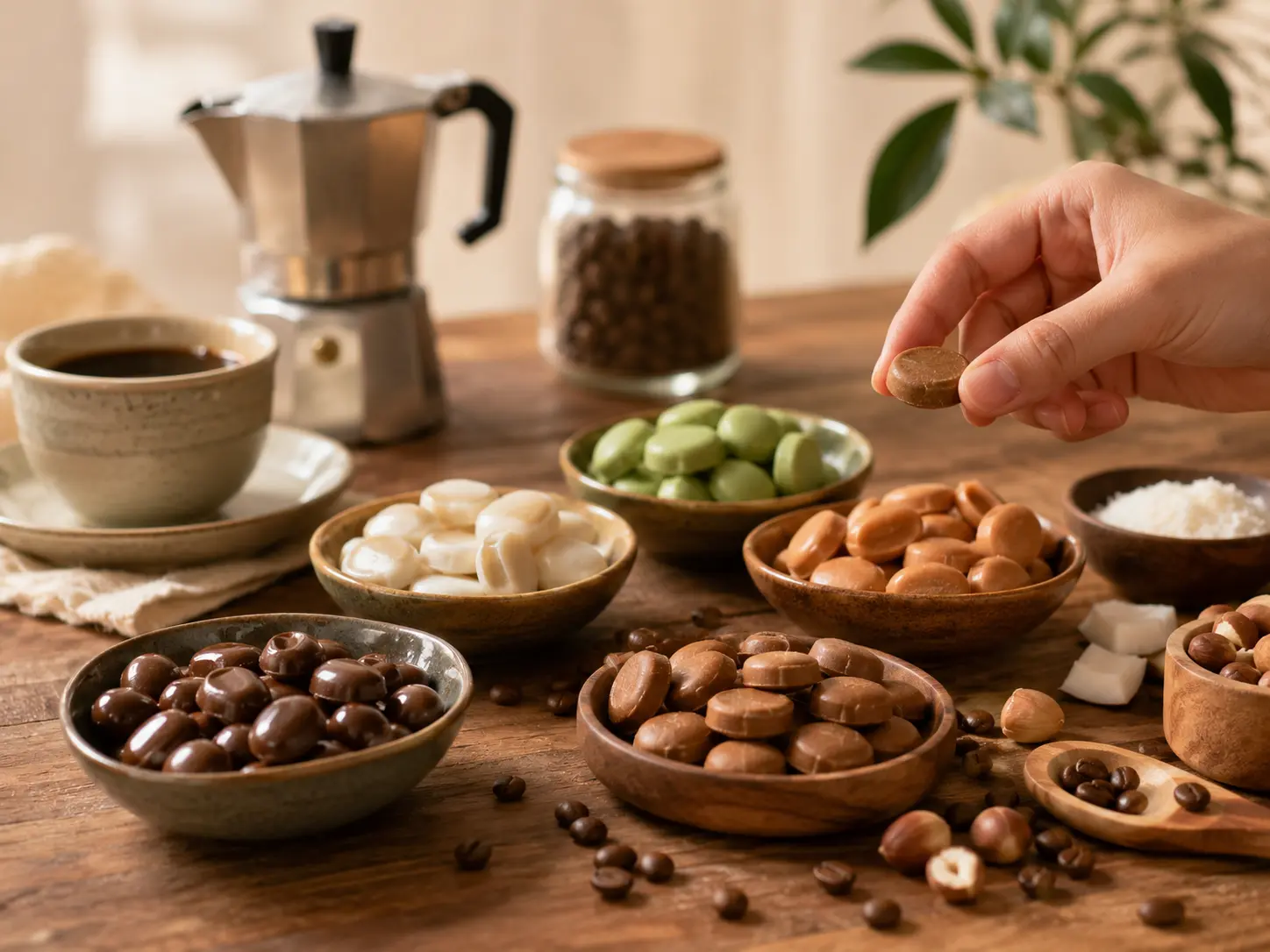
Coffee Candy is a confectionery product developed around a coffee-inspired flavor profile. Depending on the formulation and manufacturing process, it may be produced as a pressed tablet, hard candy, chewy candy, filled candy, or another confectionery format.
A key distinction for B2B buyers is that coffee flavor does not automatically mean the product contains a significant amount of caffeine. A candy may use coffee flavoring without relying on coffee-derived caffeine, while another formulation may contain coffee extract, coffee powder, or intentionally added caffeine. The actual composition must therefore be confirmed through the manufacturer’s formulation and product specification rather than inferred from the product name.
For buyers looking for a ready-to-develop product range, a dedicated Coffee Candy product category can also provide a useful starting point for comparing flavor, shape, packaging, and customization options.
From a commercial perspective, coffee candy can fit several channels: convenience stores, supermarkets, specialty food shops, coffee retailers, hotels, corporate gifts, promotional products, and e-commerce. Its compact format also makes it easier to package into small retail units or individual portions.
What Is Pressed Coffee Candy?
Pressed candy is manufactured differently from conventional boiled hard candy. Instead of relying primarily on cooking and depositing a sugar syrup, a pressed product generally uses prepared dry or granular ingredients that are blended and mechanically compressed into a defined shape.
This makes Pressed Coffee Candy particularly interesting for B2B customization. Tablet diameter, thickness, weight, embossing, shape, surface finish, and packaging can all become part of the product specification.
| Parameter | Pressed Coffee Candy | Traditional Hard Candy |
|---|---|---|
| Main forming method | Compression | Cooking and forming/depositing |
| Product structure | Compact tablet | Glassy or molded confectionery |
| Weight control | Highly controllable through formulation and tooling | Controlled through depositing/forming |
| Custom embossing | Highly suitable | Usually more limited |
| Shape customization | High | Medium to high |
| Flavor distribution | Dependent on powder blending | Dependent on syrup mixing |
| Main quality concerns | Hardness, friability, weight, cracking | Moisture, crystallization, shape, surface |
| Packaging requirements | Moisture and mechanical protection | Moisture and temperature protection |
For a B2B buyer, this difference matters because a candy that looks attractive in a sample may still perform poorly during high-volume production if its hardness, friability, weight consistency, or packaging protection is not properly controlled.
How Is Coffee Candy Made?
A professional Coffee Candy Factory normally treats production as a series of controlled stages rather than one simple manufacturing step.
Ingredient Selection and Formula Development
Depending on the product concept, a formulation may include sugar or other sweetening ingredients, coffee flavor, coffee-derived ingredients, food acids where appropriate, colors where applicable, and processing aids permitted for the target market.
The formulation should be developed according to the destination country’s food regulations. Ingredient names, additives, allergens, nutrition information, and permitted claims can differ between markets.
FDA guidance states that food manufacturers generally need to declare ingredients on packaged foods, while ingredients are normally listed in descending order of predominance by weight, subject to applicable exemptions.
Powder Preparation and Blending
For pressed products, raw materials must have suitable physical properties for blending and compression. Important considerations can include:
- Particle size
- Moisture level
- Powder flowability
- Ingredient distribution
- Flavor uniformity
- Anti-caking behavior
- Compression characteristics
A poorly blended formula can create inconsistent flavor from piece to piece, while unsuitable powder characteristics can contribute to cracking, sticking, weight variation, or poor tablet definition.
Compression and Forming
The blended material is placed into a compression system where controlled mechanical force forms individual pieces.
For custom Coffee Candy OEM projects, tooling can be developed for different shapes, sizes, logos, or embossed designs. The exact achievable specification depends on the formulation, equipment, mold design, and required production speed.
A useful indicative specification framework for early B2B discussions is:
| Specification | Typical Project Consideration |
|---|---|
| Individual weight | Approximately 1.5–5.0 g |
| Tablet thickness | Approximately 3–10 mm |
| Weight tolerance | Project-specific, commonly controlled around a defined target |
| Shape | Round, oval, custom or embossed |
| Surface | Smooth, matte, embossed or customized |
| Hardness | Adjusted according to product and packaging requirements |
| Shelf life | Commonly 12–24 months when formulation and packaging support it |
These figures should be treated as indicative development ranges rather than universal specifications. A final specification should always be confirmed through product samples and technical documentation.
Building a Reliable Coffee Candy Manufacturing Process
A capable manufacturer should control more than the final appearance. Production management should include raw-material verification, batching, blending, compression, inspection, packaging, warehousing, and shipment preparation.
This is where the difference between a product seller and an experienced manufacturer becomes commercially important.
A professional supplier should be able to discuss:
- Raw-material specifications
- Flavor specifications
- Production tolerances
- Batch identification
- Quality inspection
- Packaging materials
- Finished-product testing
- Storage requirements
- Export documentation
For B2B buyers, it is useful to request a product specification sheet before placing a large order. The document should clearly define piece weight, dimensions, ingredients, flavor, color, packaging, shelf life, storage requirements, and applicable certifications.
If you are comparing suppliers based on manufacturing experience, production capabilities, and product development support, reviewing the manufacturer’s company background can also help establish whether it is equipped for long-term B2B cooperation.
About the manufacturer The objective should be to establish a repeatable manufacturing standard rather than simply approving one attractive sample.
Coffee Candy Ingredients and Flavor Development
One of the biggest opportunities in this category is flavor segmentation. A single coffee flavor can be developed into a broader product portfolio.
Common concepts include:
- Original Coffee
- Black Coffee
- Espresso
- Cappuccino
- Latte
- Mocha
- Caramel Coffee
- Hazelnut Coffee
- Coconut Coffee
- Matcha Coffee
- Vanilla Coffee
The balance between sweetness and coffee character is particularly important. A product designed for mainstream retail may require a smoother and sweeter profile, while a premium coffee-oriented product may benefit from a stronger roasted or espresso-inspired character.
Coffee Flavor Versus Real Coffee Ingredients
There are several formulation approaches.
| Ingredient Approach | Flavor Character | Development Consideration |
|---|---|---|
| Coffee flavor | Consistent and controllable | Suitable for standardized production |
| Coffee extract | More coffee-derived character | Requires formulation and stability control |
| Coffee powder | Distinct coffee character | May influence color and texture |
| Coffee plus flavor blend | Flexible and balanced | Useful for differentiated products |
For private-label projects, the best choice depends on the target consumer, cost position, regulatory requirements, desired flavor intensity, and product positioning.
A Multi-Flavor Coffee Candy Portfolio
A strong B2B product line does not necessarily need dozens of flavors at launch. A more practical strategy is to begin with one recognizable core flavor and then build complementary variants.
An Original Coffee Candy can act as the mainstream SKU because it communicates the category immediately and can be positioned for mass retail.
A darker profile can then be developed around Black Coffee Candy, which may appeal to consumers looking for a stronger, less dessert-like coffee experience.
For a sweeter premium direction, Caramel Coffee Candy combines familiar caramel sweetness with coffee flavor and can work well for gift packs, impulse products, and specialty retail.
The advantage of this portfolio strategy is that buyers can test several consumer preferences while retaining a common product category and manufacturing platform.
Does Coffee Candy Contain Caffeine?
This is one of the most important questions for consumers and B2B buyers.
Coffee flavor does not automatically mean that a candy contains meaningful caffeine.
Caffeine content depends on the actual formula and ingredients. A manufacturer may use a coffee flavor that does not contribute significant caffeine, or the formula may contain coffee extract, coffee powder, or added caffeine.
For this reason, buyers should not make assumptions based only on the words “coffee” or “espresso” on the product name. Before commercial production, request:
- Full ingredient specification
- Caffeine information where relevant
- Nutrition information
- Certificate of analysis where applicable
- Target-market labeling review
If caffeine is deliberately added, the regulatory and labeling implications should be assessed for the destination market before artwork is finalized.
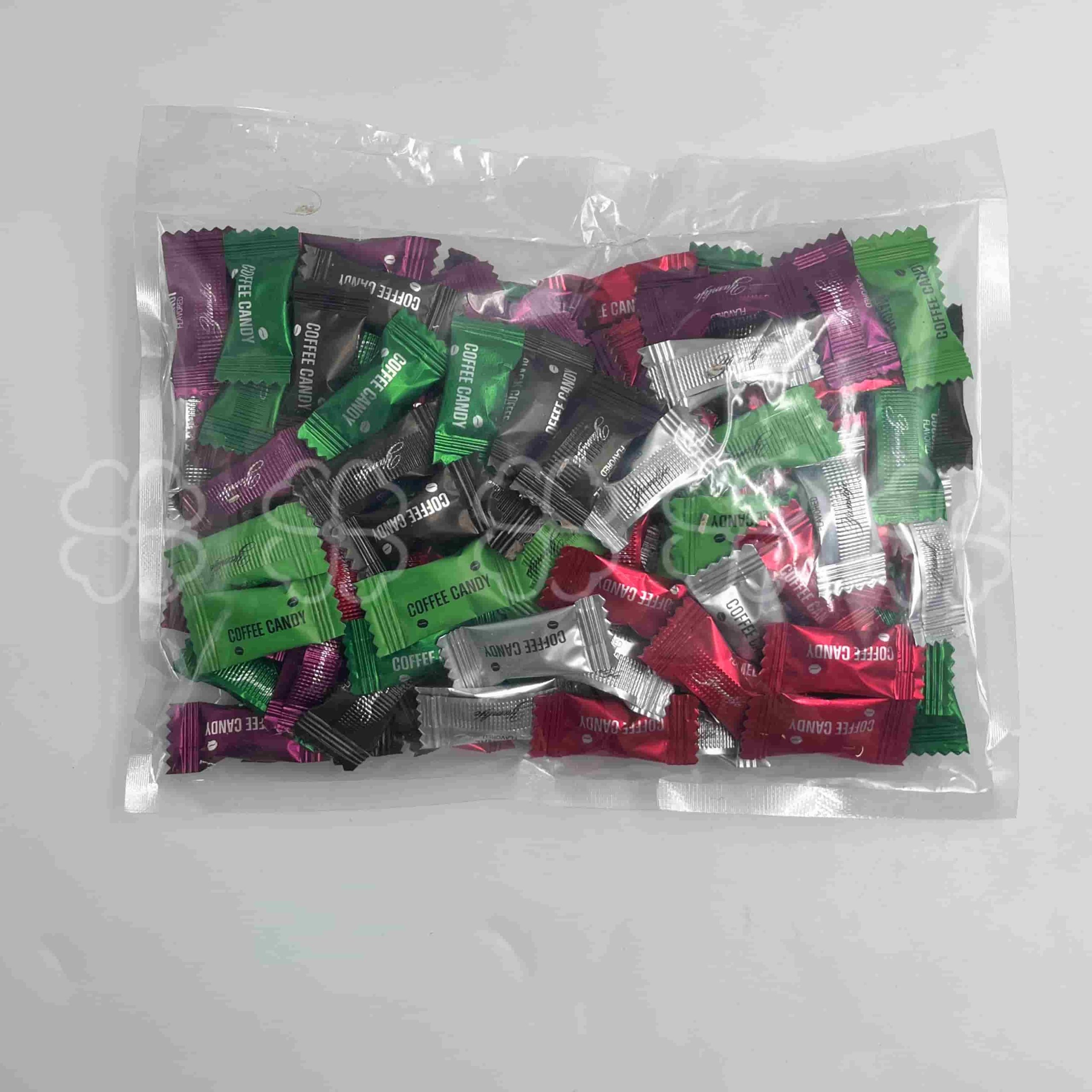
coffee candy
Coffee Candy OEM and Private Label Opportunities
The commercial value of Private Label Coffee Candy is that the product can be developed around a brand’s own market positioning rather than being treated as a generic commodity.
What Can Be Customized?
Depending on the manufacturer’s capabilities, buyers may be able to customize:
- Flavor
- Sweetness
- Coffee intensity
- Piece weight
- Tablet size
- Shape
- Embossing
- Logo
- Packaging
- Pack count
- Retail carton
- Display box
- Private-label artwork
This makes the category suitable for importers, distributors, supermarket chains, coffee companies, hospitality groups, promotional-product businesses, and online brands.
A premium flavor extension such as Hazelnut Coffee Candy can provide a more dessert-oriented positioning while keeping coffee as the core identity.
The important point is that customization should be evaluated as a complete project. A custom flavor may affect ingredient cost, production feasibility, testing, MOQ, packaging, and lead time.
Matcha, Coconut and Other Cross-Category Coffee Flavors
Flavor innovation can also move beyond traditional coffee profiles.
A Matcha Coffee Candy concept can combine the visual and flavor identity of two established beverage categories. Such products may be particularly suitable for brands targeting younger consumers or markets where matcha has strong recognition.
Similarly, Coconut Coffee Candy can create a softer tropical profile while retaining the recognizable coffee base.
From a product-development perspective, cross-category flavors should be tested carefully. Coffee can have roasted, bitter, creamy, nutty, or caramelized notes, so a second flavor should complement rather than overpower the coffee profile.
This is why sample approval is more valuable than choosing a flavor from a catalog alone.
Coffee Candy Wholesale: What Determines the Price?
A common B2B search is “How much does coffee candy cost wholesale?” There is no single universal price because the product specification can vary substantially.
The main cost drivers include:
- Ingredient selection
- Coffee flavor type
- Piece weight
- Product complexity
- Custom mold
- Packaging format
- Printing
- Order quantity
- Testing requirements
- Certification requirements
- Shipping terms
A simple cost comparison illustrates why the cheapest unit price is not always the best commercial choice.
| Cost Factor | Supplier A | Supplier B |
|---|---|---|
| Candy unit price | Lower | Slightly higher |
| Packaging quality | Basic | Higher protection |
| Weight consistency | Standard | Tighter project control |
| Customization | Limited | High |
| Quality documentation | Basic | More comprehensive |
| Potential damage/rework | Higher | Lower |
| Total landed-cost risk | Higher | Potentially lower |
The correct purchasing metric is therefore total landed cost, not simply factory unit price.
A buyer should consider product price, packaging, freight, duties, inspection, potential breakage, rejected goods, rework, and delivery risk together.
How to Choose a Coffee Candy Manufacturer
Choosing a Coffee Candy Manufacturer should involve more than checking a website and requesting a quotation.
Production Capability
Ask whether the manufacturer can handle:
- Pressed candy production
- Custom molds
- Flavor development
- Packaging
- Large-volume orders
- Private-label artwork
- Export documentation
Quality Control
Ask how the factory controls:
- Raw materials
- Production batches
- Tablet weight
- Shape
- Hardness
- Friability
- Flavor consistency
- Packaging seals
- Finished goods
For U.S.-bound products, food facilities subject to the applicable FDA preventive-controls requirements may need hazard analysis, written food safety plans, and preventive controls.
Documentation
Before placing a substantial order, request relevant documentation such as:
- Product specification
- Ingredient list
- Nutrition information
- Allergen declaration
- Certificate of analysis where appropriate
- Shelf-life information
- Manufacturing certifications
- Packaging specification
Coffee Candy Quality Parameters B2B Buyers Should Check
A professional sample approval process should evaluate more than taste.
| Quality Parameter | What the Buyer Should Check |
|---|---|
| Appearance | Shape, color and surface consistency |
| Weight | Average weight and individual variation |
| Dimensions | Diameter, thickness and shape |
| Hardness | Appropriate resistance during handling |
| Friability | Resistance to chipping and breakage |
| Flavor | Coffee intensity and balance |
| Aroma | Consistency with approved profile |
| Packaging | Seal integrity and protection |
| Shelf life | Confirmed stability period |
| Carton packing | Quantity and transport protection |
For large orders, a written “golden sample” is highly recommended. The approved sample can serve as the reference for flavor, color, shape, weight, packaging, and appearance during subsequent production.
Food Regulations and Labeling Requirements
Food regulations should be considered at the beginning of a private-label project, not after packaging artwork has been printed.
United States
For products marketed in the United States, packaged-food labeling can involve requirements covering ingredients, nutrition information, allergens, product identity, and other applicable statements. FDA states that most prepared foods require proper labeling, including nutrition labeling and major allergen labeling where applicable.
The FDA’s current allergen guidance identifies nine major food allergens in the United States: milk, egg, fish, crustacean shellfish, tree nuts, peanuts, wheat, soybeans, and sesame.
European Union
For prepacked foods sold in the EU, Regulation (EU) No. 1169/2011 establishes mandatory food-information requirements. These include the name of the food, ingredients, relevant allergens, net quantity, durability information, and applicable storage or use information.
The EU also generally requires nutrition declarations for most prepacked foods, including energy, fat, saturates, carbohydrate, sugars, protein, and salt, normally expressed per 100 g or 100 ml.
Because requirements vary by destination, the manufacturer and importer should confirm the final label against the regulations applicable to the target market.
Common Mistakes When Buying Coffee Candy
Choosing Only by Unit Price
A low quotation can become expensive if the product has inconsistent weight, poor packaging, high breakage, or inadequate documentation.
Assuming Coffee Flavor Means Caffeine
The product formula must be checked rather than making assumptions from the product name.
Ignoring Tablet Hardness and Friability
Pressed products must survive manufacturing, packing, shipping, and retail handling.
Approving Packaging Before Product Development
The final dimensions and weight can affect pack count, pouch size, carton quantity, and shipping efficiency.
Ordering Too Much Before Sample Approval
A small approved sample stage can reduce the financial risk of a large production run.
Treating Every Market as Having the Same Labeling Rules
U.S., EU, and other markets can have different requirements for ingredients, allergens, nutrition information, language, and claims.
How to Evaluate Coffee Candy Samples Before Mass Production
A practical B2B sample checklist should include:
| Test Area | Buyer Question |
|---|---|
| Appearance | Does the product match the approved design? |
| Flavor | Is the coffee intensity appropriate? |
| Sweetness | Is the balance suitable for the target market? |
| Texture | Is hardness appropriate? |
| Weight | Is the piece weight consistent? |
| Breakage | Does the product withstand normal handling? |
| Packaging | Does the package protect the candy? |
| Label | Are all required details present? |
| Storage | Does the product remain stable under intended conditions? |
For a private-label project, the final approval package should ideally include the physical sample, product specification, approved artwork, packaging specification, and any relevant technical documents.
This creates a clear reference point for both buyer and manufacturer.
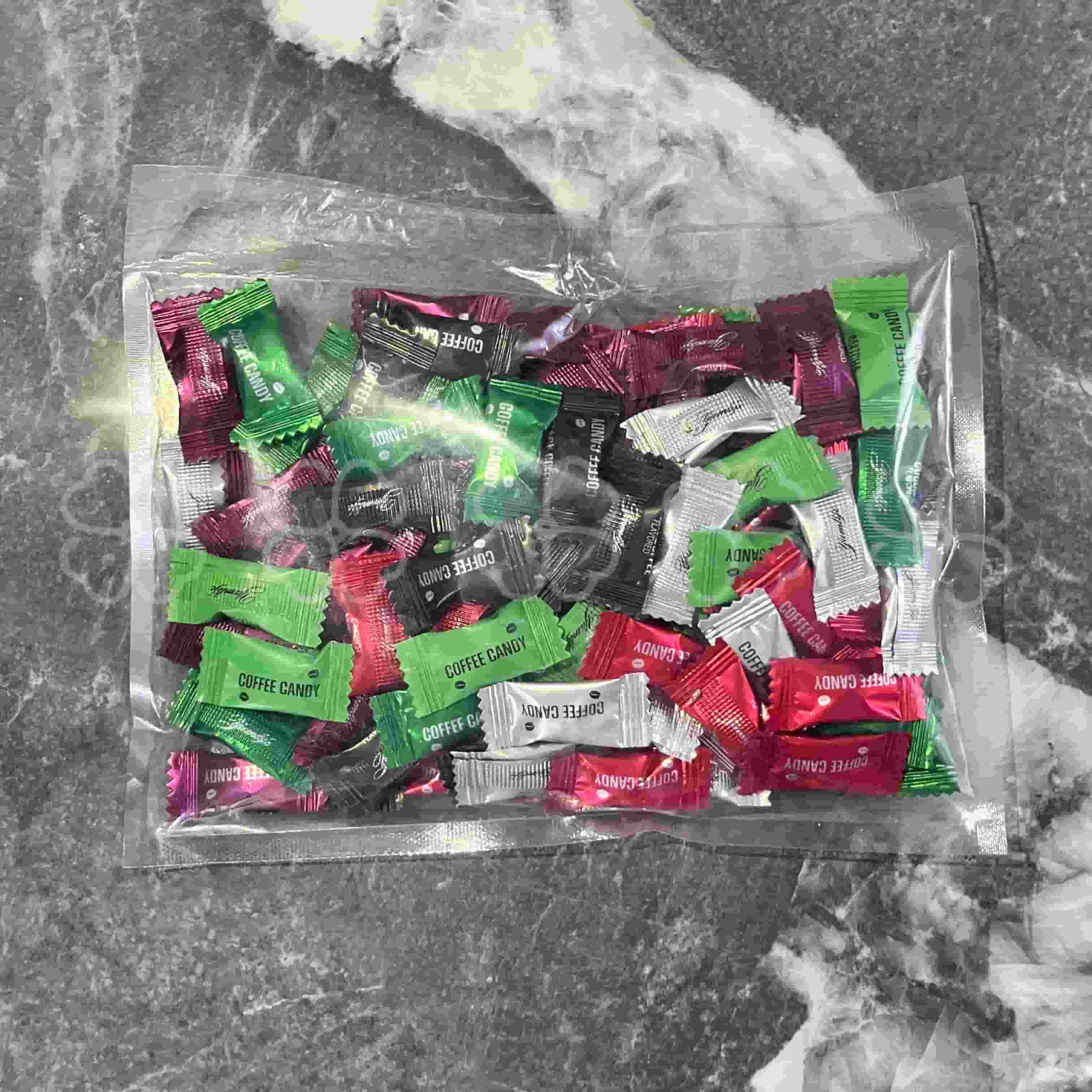
coffee candy supplier
Real-World Applications for Coffee Candy
Coffee confectionery can serve several B2B channels.
Coffee Shops and Coffee Brands
Coffee businesses can use branded candy as a checkout product, customer gift, promotional item, or complementary product.
Hotels and Hospitality
Small-format coffee candy can be considered for welcome packs, conferences, corporate hospitality, and branded guest products.
Supermarkets and Convenience Stores
Small packs can work well for impulse-purchase environments, while larger bags or jars may suit family or sharing formats.
Corporate Promotions
Custom packaging and logo embossing can turn pressed candy into a branded promotional item for exhibitions, events, and business campaigns.
For B2B buyers who already have a defined product idea, direct communication with the supplier is useful because specifications such as flavor, packaging, MOQ, and target market can significantly affect the feasibility of the project.
Contact the manufacturer for a Coffee Candy project
Building a Coffee Candy Product Line
A scalable product line can begin with one core flavor and expand gradually.
A possible structure is:
Original Coffee → Black Coffee → Caramel Coffee → Hazelnut Coffee → Coconut Coffee → Matcha Coffee
The strategy provides multiple flavor identities while keeping coffee as the central category.
For example, a retailer could launch an original flavor as the entry SKU, add black coffee for a stronger taste profile, then introduce caramel and hazelnut for consumers who prefer sweeter flavor combinations.
This approach can reduce the complexity of launching an entirely unrelated confectionery portfolio while still giving consumers meaningful choice.
The B2B Decision: OEM, Private Label or Wholesale?
The best purchasing model depends on the buyer’s business objective.
| Model | Customization | MOQ | Development Time | Best For |
|---|---|---|---|---|
| Standard Wholesale | Low | Usually lower | Shorter | Distributors and retailers |
| Private Label | Medium to high | Medium | Medium | Brand owners |
| OEM | High | Usually higher | Longer | Custom product developers |
Wholesale is appropriate when speed and simplicity are priorities.
Private label is useful when the buyer wants its own brand identity without developing every element from scratch.
OEM is more suitable when flavor, shape, formulation, packaging, or product specifications need substantial customization.
A Practical Buying Strategy for Coffee Candy
For a new project, buyers can follow a five-stage process:
Stage 1 — Define the Market
Identify destination country, consumer group, sales channel, and target price.
Stage 2 — Define the Product
Specify flavor, piece weight, format, packaging, and desired shelf life.
Stage 3 — Request Samples
Evaluate taste, appearance, hardness, weight, packaging, and overall quality.
Stage 4 — Confirm Compliance
Review ingredients, allergens, nutrition information, labeling, certificates, and destination-market requirements.
Stage 5 — Approve the Golden Sample
Use the approved sample and specification as the reference for mass production.
This process helps prevent a common B2B problem: agreeing on price before the product specification has actually been finalized.
Frequently Asked Questions About Coffee Candy
1. What Is Coffee Candy Made Of?
Coffee candy can be made from sugar or other permitted sweetening ingredients combined with coffee flavoring and, depending on the formula, coffee extract, coffee powder, food acids, colors, and other permitted processing ingredients. The exact formulation varies by manufacturer and target market. Buyers should request a complete ingredient specification before approving a commercial product, particularly when the candy will be sold under a private label.
2. Does Coffee Candy Contain Caffeine?
Not necessarily. A coffee-flavored candy can use flavoring without providing a significant amount of caffeine. Other products may contain coffee extract, coffee powder, or intentionally added caffeine. Therefore, caffeine content must be confirmed from the actual product formulation rather than inferred from the name “Coffee Candy.” If caffeine is added, the buyer should review the applicable labeling and regulatory requirements for the destination market.
3. How Is Pressed Coffee Candy Made?
Pressed Coffee Candy is generally produced by preparing and weighing ingredients, blending the formulation, preparing a suitable powder or granular mixture, compressing the material into individual tablets, inspecting the finished pieces, and packaging them. Important quality factors include particle characteristics, moisture control, weight consistency, hardness, friability, flavor distribution, shape accuracy, and packaging protection.
4. Can I Order Private Label Coffee Candy From a Manufacturer?
Yes. Depending on the manufacturer’s capabilities, private-label projects can include customized flavor, sweetness, piece weight, shape, embossing, packaging, pack count, and artwork. The buyer should provide information about the destination market, estimated order quantity, desired packaging, target price, and product concept so the manufacturer can assess feasibility and provide an appropriate quotation and sample-development plan.
5. How Do I Choose a Coffee Candy Manufacturer?
A buyer should evaluate production capability, product-development experience, quality-control procedures, food-safety systems, documentation, customization options, MOQ, packaging capabilities, lead time, and export experience. Unit price should not be the only decision factor. Consistent quality, reliable packaging, regulatory preparation, communication, and total landed cost can have a greater effect on the long-term profitability of a Coffee Candy product.
Turning Coffee Candy Into a Reliable B2B Product
The opportunity in Coffee Candy is not simply about putting coffee flavor into a piece of confectionery. For importers, retailers, distributors, and private-label brands, the real opportunity is to create a consistent product that combines recognizable flavor, convenient consumption, attractive packaging, scalable manufacturing, and market-specific compliance.
For pressed products, manufacturing quality matters at every stage. Powder characteristics influence compression. Compression influences tablet integrity. Tablet integrity influences packaging performance. Packaging influences transportation and shelf presentation. Finally, all of these factors influence the buyer’s total landed cost and repeat-purchase potential.
A successful Pressed Coffee Candy project therefore begins with clear specifications rather than a generic request for “coffee candy.”
The strongest supplier relationship is built around transparent communication, approved samples, documented specifications, quality controls, realistic MOQs, appropriate packaging, and destination-market requirements.
For brands seeking differentiation, a combination of original coffee, black coffee, caramel, hazelnut, coconut, and matcha-inspired concepts can create a broader portfolio without losing the central coffee identity. The right Private Label Coffee Candy strategy can then turn one product into a repeatable branded category.
Feature Product
-
 Gummy Candy
What Is Gummy Candy? Gummy Candy is one of the ...
-
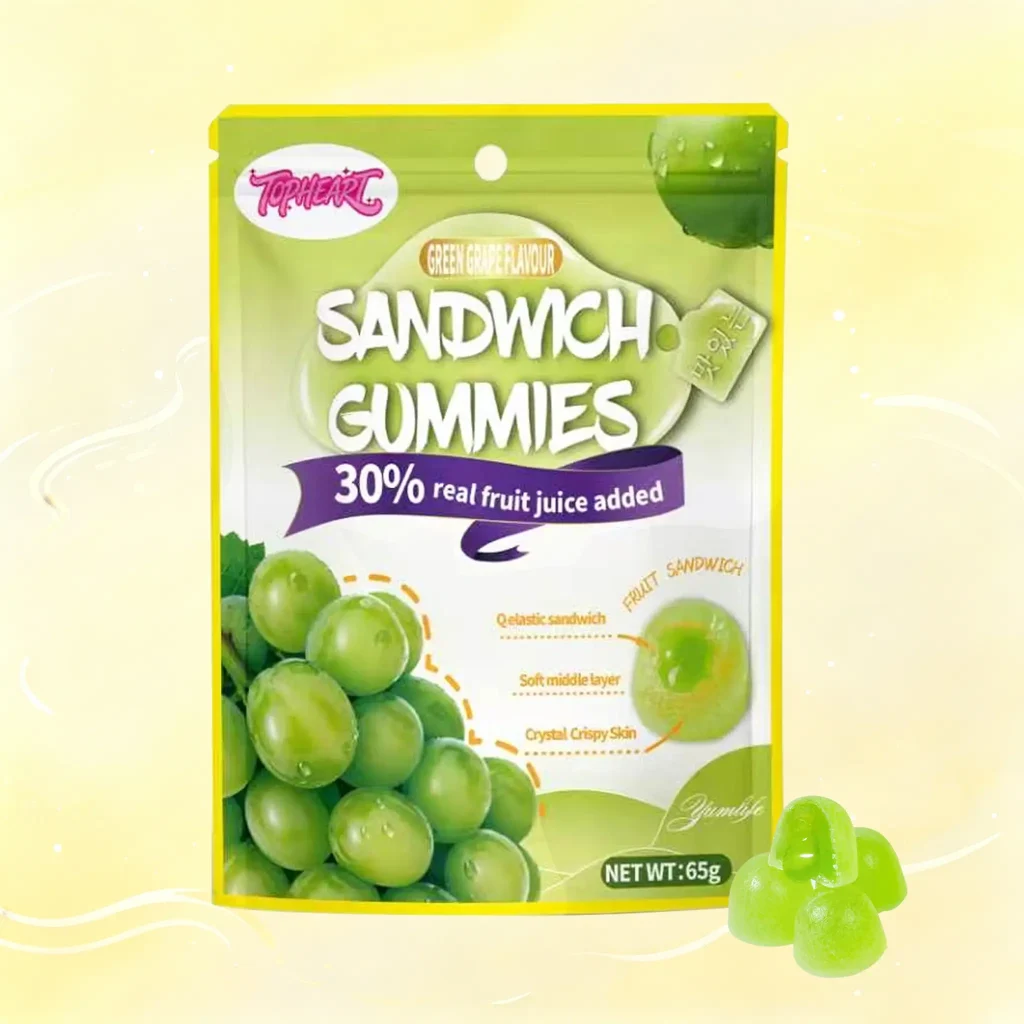 Crispy Gummy Candy
What Is Crispy Gummy Candy Crispy Gummy Candy i...
-
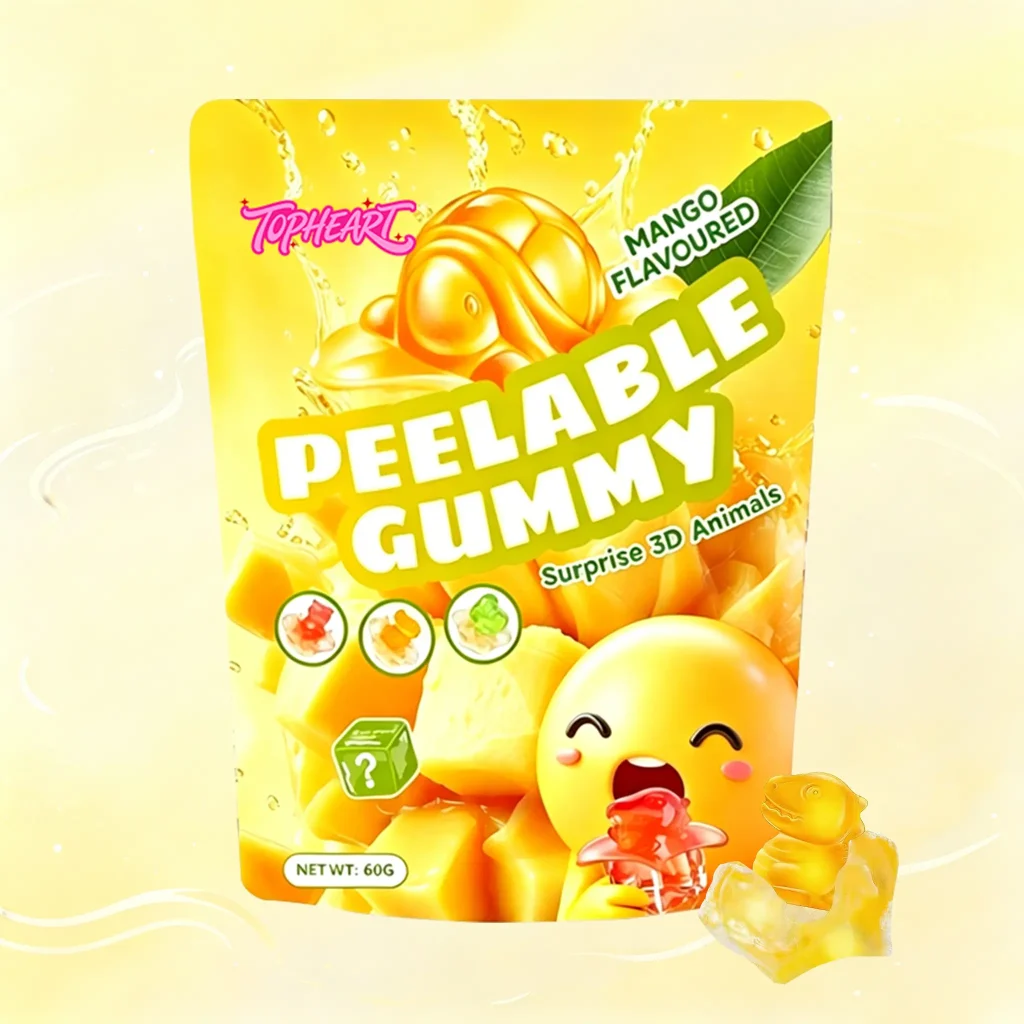 Peelable Gummy Candy
What Is Peelable Gummy Candy? Peelable Gummy Ca...