


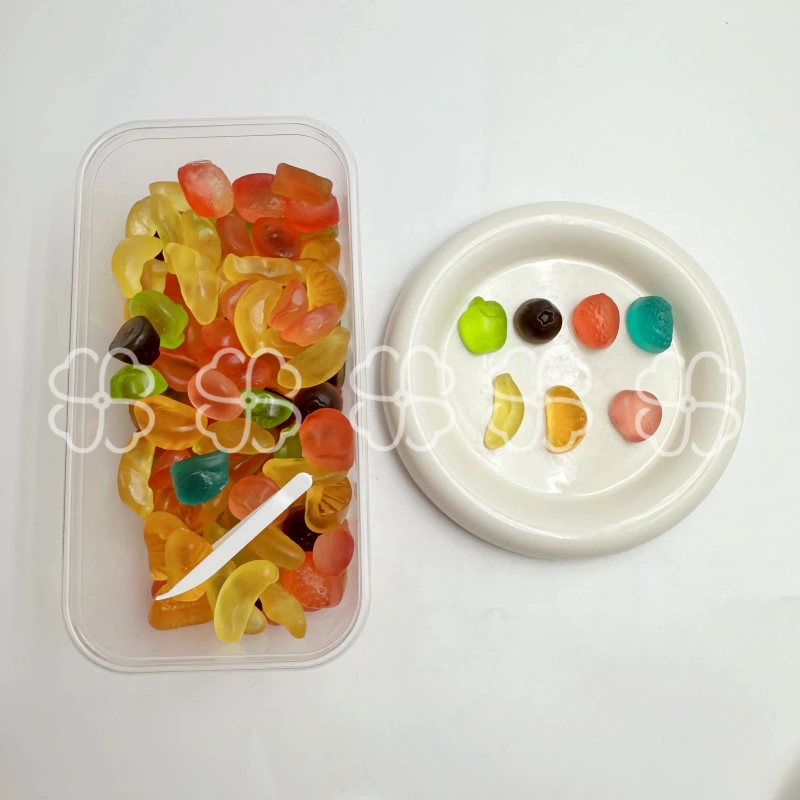
A 360g sugar-coated tray soft candy format combines a chewy confectionery center with a visible sugar-coated surface and a practical retail-oriented tray pack. For importers, distributors, wholesalers, supermarket suppliers, and private label buyers, the format offers a useful balance between product presentation, portion size, customization, and shipping efficiency. When sourcing this type of candy, however, the important questions extend beyond flavor and price. Buyers need to evaluate sugar coating stability, texture consistency, moisture management, packaging performance, production capability, and export documentation.
For companies developing a new confectionery line, working with an experienced 360g sugar-coated tray soft candy manufacturer can simplify product development from sample approval through mass production. A suitable supplier should be able to discuss flavor, shape, coating, tray configuration, packaging materials, carton specifications, quality control, and private label requirements as one connected production system.
What Is 360g Sugar-Coated Tray Soft Candy?
360g sugar-coated tray soft candy is a soft and chewy confectionery product supplied in a tray-style retail pack with a nominal net weight of 360 grams. The candy itself generally has a flexible or chewy center, while the exterior is covered or mixed with visible sugar crystals or a sugar-based coating.
The combination creates two sensory layers. The first is the crystalline or granular sensation from the sugar-coated exterior. The second is the softer, chewy texture of the candy center. This contrast can make the product more noticeable on retail shelves and can also create opportunities for sour, fruity, or mixed-flavor positioning.
The 360g format is particularly relevant for buyers looking for a medium-to-large retail pack rather than a small impulse pouch. It can work for family sharing, party occasions, candy stores, supermarkets, wholesalers, and promotional displays.
From a sourcing perspective, buyers should not treat the 360g specification as only a weight requirement. The final commercial product depends on the relationship between candy dimensions, tray capacity, coating quantity, moisture control, packaging barrier properties, and carton configuration.
For buyers evaluating a Chinese supplier, understanding the manufacturer’s production capability is also important. A useful starting point is the supplier’s factory background, product development experience, export markets, and quality-management approach. Candy-Food provides its company information through its candy manufacturer company profile.
Why Choose a 360g Tray Format for Soft Candy?
The tray format can provide several commercial advantages when the target market values product visibility and convenient shelf presentation.
First, a tray can help maintain a defined product arrangement. Instead of allowing every piece to move freely inside a large flexible pouch, the tray can provide a more organized presentation. This can be useful for products with distinctive shapes, multiple colors, or visually important sugar coatings.
Second, 360g is a practical size for products positioned above single-serving impulse candy but below very large bulk formats. Retailers can potentially position the product in confectionery aisles, family-sharing sections, seasonal displays, or promotional areas.
Third, the format can support private label development. The same basic candy concept can be adapted through different flavors, colors, shapes, sugar coatings, labels, outer packaging, and carton configurations.
For wholesalers, packaging efficiency matters as much as consumer appearance. A supplier should therefore provide information about unit dimensions, units per carton, carton dimensions, gross weight, net weight, pallet configuration, and estimated loading efficiency.
A good 360g sugar-coated soft candy wholesale project should therefore evaluate the complete supply chain rather than only the factory quotation.
How Sugar Coating Influences Texture and Product Performance
Sugar coating is not simply a decorative element. It influences how the candy feels during the first bite and how the surface behaves during transportation and storage.
A relatively dry sugar surface can provide a crisp or granular sensation before the consumer reaches the softer candy center. If moisture migrates excessively from the candy into the coating, the surface may become less crystalline, sticky, or visually uneven.
This makes moisture management particularly important for sugar-coated soft candy.
Important technical factors include:
- Candy moisture content
- Water activity
- Sugar particle size
- Coating uniformity
- Candy center formulation
- Packaging moisture barrier
- Storage temperature
- Relative humidity
- Transportation conditions
- Seal integrity
Water activity is particularly useful because it describes the availability of water in a food system rather than simply the total amount of moisture. For confectionery manufacturers, monitoring water activity can support texture consistency and shelf-life evaluation.
The exact target values should be established through product-specific testing rather than copied from another candy formula.
Typical Technical Parameters to Discuss With a Manufacturer
| Parameter | Why It Matters | Buyer Consideration |
|---|---|---|
| Net weight | Defines retail specification | 360g target |
| Candy piece weight | Influences portion and tray loading | Confirm acceptable tolerance |
| Moisture | Affects chewiness and coating stability | Establish product specification |
| Water activity | Helps evaluate available water | Validate during development |
| Sugar coating | Determines surface texture | Check uniformity |
| Piece dimensions | Determines tray fit | Confirm mold and cavity compatibility |
| Packaging barrier | Helps protect texture | Match packaging to climate |
| Seal integrity | Reduces exposure to humidity | Include packaging QC |
| Shelf life | Supports retail distribution | Confirm with stability testing |
| Carton configuration | Affects logistics cost | Review before purchase |
These figures should be treated as development and quality-control parameters rather than universal specifications. A professional manufacturer should establish the final limits based on the actual recipe, coating process, packaging, and destination market.
360g Sugar-Coated Tray Soft Candy OEM Options
OEM development allows importers and distributors to build a product around their own market positioning rather than purchasing a fixed stock item.
A sugar-coated soft candy OEM project can potentially include:
Flavor Customization
Fruit flavors are common choices for soft candy because they provide broad consumer recognition and can work well with colorful sugar coatings.
Possible directions include:
- Strawberry
- Grape
- Mango
- Peach
- Apple
- Watermelon
- Mixed fruit
- Lemon
- Orange
- Berry combinations
- Sweet and sour profiles
The final flavor selection should be based on the target market, expected retail positioning, and regulatory requirements.
Shape Customization
Shape can contribute significantly to product differentiation. Manufacturers may develop fruit shapes, geometric pieces, animal shapes, seasonal shapes, or proprietary molds.
Shape development should consider not only appearance but also:
- Mold complexity
- Demolding performance
- Coating coverage
- Piece-to-piece consistency
- Tray cavity dimensions
- Packaging stability
Sugar Coating Customization
The surface can be developed around different sensory objectives.
For example, a standard sugar coating may emphasize sweetness and visual texture, while a sour sugar coating can create a sharper flavor experience.
Buyers should confirm whether the requested coating is:
- Fine sugar
- Coarse sugar
- Colored sugar
- Sour sugar
- Mixed sugar
- Flavored coating
- Customized coating blend
Packaging Customization
Private label packaging may include:
- Tray structure
- Printed sleeve
- Outer carton
- Printed film
- Label
- Barcode
- Nutrition panel
- Ingredient declaration
- Country-of-origin statement
- Batch information
- Date coding
- Retail display configuration
Packaging should be finalized only after confirming the actual product dimensions and shipping conditions.
360g Sugar-Coated Tray Soft Candy Wholesale Buying Guide
Wholesale buyers normally need more information than retail consumers.
A professional RFQ should specify at least:
- Product name
- Net weight
- Flavor
- Shape
- Sugar coating
- Packaging format
- Private label requirement
- Target quantity
- Destination country
- Required certifications or compliance documents
- Target delivery date
- Shipping term
- Sample requirement
For a 360g sugar-coated tray soft candy wholesale order, the carton configuration is especially important.
For example, a buyer should ask for:
| Commercial Specification | Information to Request |
|---|---|
| Net weight | 360g per retail unit |
| Units per carton | Confirm supplier configuration |
| Carton net weight | Confirm |
| Carton gross weight | Confirm |
| Carton dimensions | Confirm |
| Pallet quantity | If applicable |
| MOQ | Confirm by packaging and flavor |
| Sample lead time | Confirm |
| Mass-production lead time | Confirm |
| Packaging MOQ | Confirm |
| Private label setup | Confirm |
| Export documents | Confirm |
This information allows buyers to compare suppliers on landed cost rather than simply comparing the factory unit price.
How to Evaluate a 360g Sugar-Coated Tray Soft Candy Manufacturer
The supplier selection process should focus on production consistency and communication as much as price.
A reliable 360g sugar-coated tray soft candy manufacturer should be able to explain how it controls raw materials, cooking or forming conditions, coating, drying or conditioning, packaging, metal detection where applicable, finished-product inspection, and shipment release.
Buyers should ask whether the manufacturer can provide:
- Product specifications
- Ingredient information
- Allergen information where applicable
- Packaging specifications
- Product samples
- Production photos or factory information
- Quality-control documentation
- Export documentation
- Batch traceability information
- Certificate information where applicable
It is also useful to determine whether the supplier has experience handling private label packaging. A factory that can coordinate product development and packaging production can reduce communication between multiple vendors.
Candy-Food’s candy supplier contact page at can be used as the appropriate starting point for discussing product requirements, samples, OEM projects, and export inquiries.
Common Quality Risks in Sugar-Coated Soft Candy
Sugar-coated products have several quality risks that buyers should identify before placing a large order.
1. Coating Becomes Sticky
Excessive moisture migration or exposure to humid conditions can affect the surface coating.
The solution may involve formulation adjustment, conditioning, packaging improvement, or better environmental control during production.
2. Uneven Sugar Coverage
Uneven coating can make individual pieces look inconsistent.
Buyers should evaluate samples from different production batches rather than approving only a single visually attractive sample.
3. Texture Changes During Storage
A soft candy that performs well immediately after production may behave differently after several weeks under realistic storage conditions.
Shelf-life evaluation should therefore consider both the candy center and the coating.
4. Packaging Is Not Suitable for the Destination Climate
A packaging structure that works in a dry environment may require additional protection for tropical or high-humidity markets.
This is especially important for export orders moving through warehouses, ports, trucks, and retail facilities.
5. Retail Weight or Count Inconsistency
Buyers should confirm how the 360g specification is controlled and how acceptable production tolerances are defined.
Scientific Considerations for Product Development
Soft candy is a multi-component food system in which sugar, water, hydrocolloids, acids, flavors, colors, and other ingredients can interact.
The relationship between moisture and texture is especially important.
| Development Factor | Lower Level Tendency | Higher Level Tendency | What Buyers Should Check |
|---|---|---|---|
| Available moisture | Firmer surface | Softer or stickier surface | Texture stability |
| Water activity | Lower microbial availability | Greater moisture mobility | Product-specific target |
| Sugar crystallization | More controlled surface | Possible texture change | Coating consistency |
| Coating particle size | Smoother sensation | More pronounced crunch | Consumer preference |
| Storage humidity | Drier environment | Greater moisture exposure | Packaging suitability |
| Temperature | Cooler product | Softer product behavior | Distribution conditions |
These relationships are directional rather than universal formulas. The actual result depends on the complete recipe and manufacturing process.
For international projects, regulatory requirements must also be checked against the destination market. Codex Alimentarius classifies soft candy within food category 05.2.2 and includes products such as jelly-based candies and sugar-covered confectionery within the broader confectionery framework. Specific additive permissions, labeling requirements, and limits can differ by market, so buyers should verify the rules applicable to the importing country.
Private Label Opportunities for 360g Sugar-Coated Soft Candy
Private label candy is increasingly about more than putting a retailer’s logo on standard packaging.
For example, a supermarket buyer may choose a fruit-flavored sugar-coated tray candy with bright packaging and family-sharing positioning.
A specialty candy distributor may instead prefer distinctive shapes, stronger sour profiles, and multiple color combinations.
A promotional buyer may prioritize visual impact, custom packaging, and a controlled cost target.
This is why buyers should communicate the intended market before requesting a final quotation.
Common Buyer Mistakes to Avoid
Comparing Only Factory Prices
The lowest quotation may not produce the lowest landed cost.
A better comparison includes product price, packaging, carton configuration, shipping efficiency, defect risk, lead time, and potential rework.
Approving Samples Without Packaging Testing
The candy may perform well in a sample bag but behave differently in the final tray and retail package.
The final packaging should therefore be included in meaningful stability and transportation evaluation.
Treating 360g as an Exact Piece Count
The 360g specification refers to the intended net weight. The number of pieces can change depending on candy size and shape.
Buyers should specify whether they care more about weight, piece count, visual filling, or a combination.
Ignoring Destination-Market Regulations
A formulation accepted in one market may require changes in another.
Labeling, additives, colors, allergens, claims, and documentation should be reviewed before final production.
Changing Packaging Too Late
Packaging changes after product approval can create delays because tray dimensions, artwork, film specifications, cartons, and loading plans are interconnected.
A Practical OEM Decision Process
A structured development process reduces unnecessary revisions.
Step 1: Define the market
Identify country, retail channel, target consumer, price segment, and expected sales format.
Step 2: Define the product
Confirm 360g net weight, flavor, shape, coating, texture, and color direction.
Step 3: Review samples
Evaluate taste, chewiness, coating, appearance, size consistency, and packaging presentation.
Step 4: Confirm technical specifications
Document product parameters, packaging materials, tolerances, shelf-life expectations, and carton specifications.
Step 5: Review compliance
Confirm the documentation and labeling requirements applicable to the destination country.
Step 6: Approve packaging
Finalize artwork, barcode, ingredient declaration, nutrition information, packaging dimensions, and carton marks.
Step 7: Conduct production
The manufacturer should operate according to the approved specifications and quality-control procedures.
Step 8: Pre-shipment review
Verify quantity, packaging, appearance, carton condition, documentation, and shipment information before dispatch.
How to Start a 360g Sugar-Coated Tray Soft Candy Project
A practical supplier inquiry should contain enough information for the manufacturer to give a meaningful answer.
A buyer can prepare the following:
- Target market
- Flavor preference
- Sugar or sour sugar coating
- Candy shape
- 360g target weight
- Tray packaging preference
- Private label requirement
- Estimated order quantity
- Desired delivery schedule
- Required certificates or compliance documents
- Destination port
- Sample requirement
The more specific the initial brief, the easier it becomes for a manufacturer to recommend an appropriate production route.
For example, instead of simply asking for “360g soft candy price,” a buyer can ask for a quotation for a 360g sugar-coated soft candy tray with a specific flavor, shape, coating, packaging configuration, private label artwork, estimated MOQ, carton quantity, and destination market.
That type of inquiry creates a much more useful basis for comparing suppliers.
Build the Product Around the Market
A successful 360g sugar-coated tray soft candy project is not determined by one specification or one factory quotation. Product texture, sugar coating, packaging, shelf presentation, regulatory compliance, logistics, and private label requirements must work together.
For wholesalers and importers, the key decision is to select a product configuration that matches the target sales channel. For private label buyers, the priority should be consistent communication between formulation, coating, packaging, and branding. For distributors, stable production and predictable documentation can be as important as the initial product price.
A capable manufacturer should be able to move from product concept to sample, technical confirmation, packaging approval, mass production, quality control, and export preparation in a coordinated process.
For companies sourcing a 360g sugar-coated tray soft candy manufacturer, the most practical next step is to prepare a concise product brief and request samples against clearly defined specifications. Comparing actual samples, packaging performance, documentation, MOQ, lead time, and commercial terms will provide a stronger purchasing basis than comparing quotations alone.
1. What is 360g sugar-coated tray soft candy?
360g sugar-coated tray soft candy is a chewy confectionery product supplied in a tray-style retail package with a nominal net weight of 360 grams. Its exterior is covered or mixed with visible sugar crystals, creating a textured surface that contrasts with the softer candy center. The format is suitable for retail, family-sharing, wholesale, and private label applications. Buyers should evaluate not only the 360g weight but also candy size, sugar coating, texture, packaging structure, shelf-life requirements, and destination-market regulations.
2. Can I customize the flavor, shape, and sugar coating for a 360g soft candy product?
Yes, an OEM project can potentially customize flavor, candy shape, color, sugar coating, packaging, and private label artwork. Common flavor directions include strawberry, grape, mango, peach, apple, watermelon, citrus, berry, and mixed-fruit profiles. Buyers should confirm customization feasibility with the manufacturer because mold requirements, ingredient availability, minimum order quantities, packaging minimums, and production scheduling can vary according to the requested design.
3. What should I check before buying 360g sugar-coated soft candy wholesale?
Wholesale buyers should check the net weight specification, piece dimensions, flavor, coating uniformity, texture, packaging material, seal integrity, shelf-life information, carton configuration, MOQ, lead time, documentation, and destination-market compliance. It is also useful to test samples after storage under realistic conditions rather than evaluating the product only when it is freshly manufactured. This can help identify potential changes in coating texture, stickiness, appearance, or chewiness before a larger order is placed.
4. How do I choose a reliable sugar-coated soft candy manufacturer?
A reliable manufacturer should be able to provide clear product specifications, representative samples, packaging information, quality-control procedures, traceability information, relevant export documentation, and realistic production lead times. Buyers should also evaluate whether the manufacturer can coordinate candy development and private label packaging. Communication quality matters because flavor, shape, coating, tray dimensions, packaging, carton configuration, and labeling are interconnected. A supplier that clearly documents these requirements can make the OEM process easier to manage.
5. Is a 360g sugar-coated tray better than other soft candy formats?
There is no single format that is suitable for every market. A 360g sugar-coated tray can be appropriate when the buyer wants a substantial retail pack, structured presentation, visible sugar coating, and family-sharing positioning. Smaller pouches may be more convenient for impulse purchases, while peelable or 3D gummies may provide stronger novelty or visual interaction. Buyers should compare formats according to target consumers, retail channel, shelf presentation, product experience, packaging cost, shipping requirements, and intended price positioning rather than selecting a format based only on unit price.
Feature Product
-
 Gummy Candy
What Is Gummy Candy? Gummy Candy is one of the ...
-
 Crispy Gummy Candy
What Is Crispy Gummy Candy Crispy Gummy Candy i...
-
 Peelable Gummy Candy
What Is Peelable Gummy Candy? Peelable Gummy Ca...